On this page
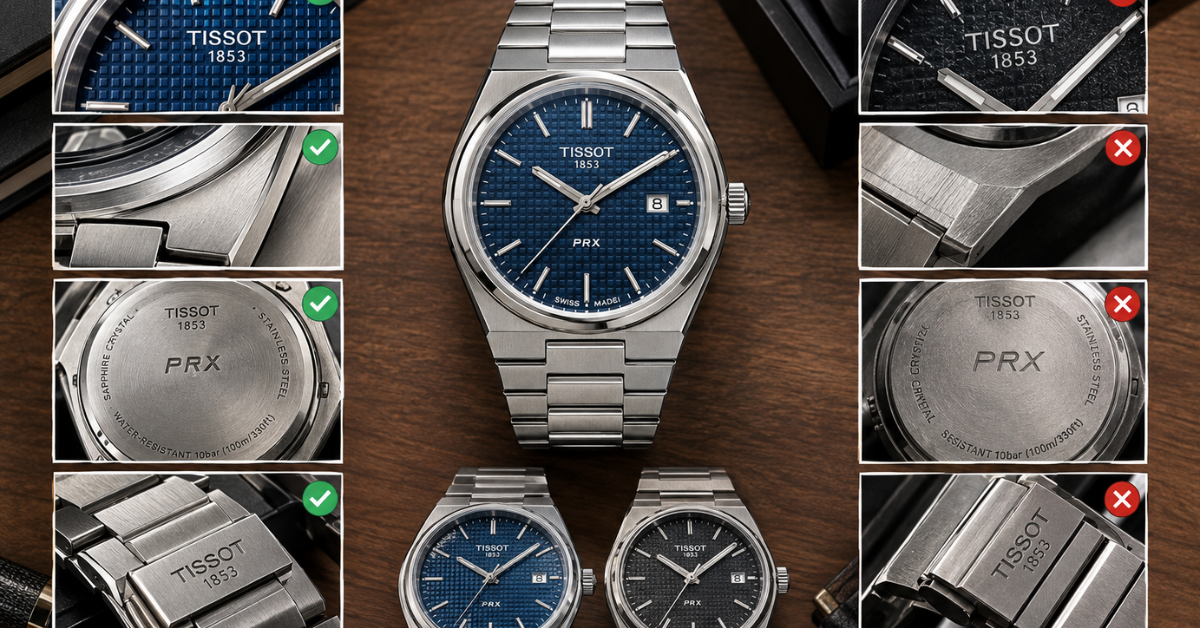
The PRX's viral popularity has made it one of the most counterfeited watches of the 2020s, with fakes ranging from obvious $20 knockoffs to convincing replicas sold at full genuine price. The most reliable checks: the waffle dial should show genuine physical depth and light play from CNC-machined squares, not a flat printed pattern; the integrated bracelet should flow seamlessly from the case with no visible gap; and on Powermatic 80 models, the movement itself is the most serious concern — documented cases show counterfeiters fitting a Powermatic-style rotor onto an entirely different base movement, with mismatched engraving fonts and spacing as the giveaway.
For our broader Tissot authentication checks, see our general guide to authenticating a Tissot against "Swiss Made" fakes. This piece focuses specifically on the PRX, which has become enough of a counterfeit target since its 2021 relaunch to warrant its own dedicated checklist. Our PRX complete guide covers the watch's real history and current lineup, useful context for confirming a specific reference actually exists before you evaluate whether the one in front of you is genuine.
1. Waffle Dial Depth
This is the fastest visual check, and it's genuinely difficult for cheap counterfeits to replicate well. A genuine PRX's waffle-pattern dial is CNC-machined or stamped with sharp, precise square edges, creating real physical depth that catches and plays with light as you tilt the watch. Counterfeits frequently substitute a flat printed pattern that shows no shadow variation when tilted, or a stamped version with noticeably rounded edges instead of crisp squares. Hold the watch at an angle under a light source — a genuine dial's depth should be immediately apparent; a flat printed fake will look noticeably two-dimensional by comparison.
2. The Case-Bracelet Transition
The PRX's defining design feature is its seamless integrated bracelet, and this is exactly where counterfeits tend to fall short. On a genuine watch, the bracelet flows directly from the case with matched finishing and no visible gap or step at the junction — a smooth, continuous line. Counterfeits commonly show a visible gap where the first bracelet link meets the case, mismatched brushing or polish between the two components, or links that don't sit fully flush. Run a finger across this transition; a genuine PRX should feel like one continuous surface, not two separate parts joined together.
3. Movement Authenticity — The Most Serious Check
This is worth taking seriously, because documented cases show counterfeiters targeting the Powermatic 80 version specifically, and the results can be convincing enough to fool an owner for weeks. In one well-documented case from a watch enthusiast forum, a buyer who purchased what was sold as a genuine PRX Powermatic 80 discovered, on close inspection of the movement, a balance wheel and escapement that didn't match genuine references at all — the rest of the watch was convincing enough that the mismatch was the only thing that gave it away. In another documented case, the movement's jewel-count engraving showed text ending in the wrong position relative to a reference hole, with distorted lettering and inconsistent spacing compared to verified genuine photos — small printing details that don't match up once you compare closely.
The underlying pattern in both cases: some counterfeits fit a Powermatic-style rotor onto a completely different, unrelated base movement rather than a genuine Powermatic 80 caliber, hoping the visual similarity holds up to casual inspection. If your PRX has a display caseback, compare the visible movement details — bridge shapes, engraving text, balance wheel construction — against verified genuine reference photos rather than assuming a rotor with "Powermatic 80" printed on it guarantees the movement underneath matches. Our Tissot Movements Explained guide covers what a genuine Powermatic 80 actually looks like and how it's built, useful for knowing what you're comparing against.
4. Date Window Alignment
A specific, documented tell worth checking directly: in at least one confirmed case, a counterfeit PRX Powermatic 80 showed a date numeral positioned too close to the top edge of the date window, with the number appearing slightly rotated once set — a small functional flaw that gave away a replica convincing enough to pass most other visual checks. If your PRX has a date function, check that the numeral sits centered and level within the window at every date, not just when you happen to glance at it.
5. Reference Number Verification
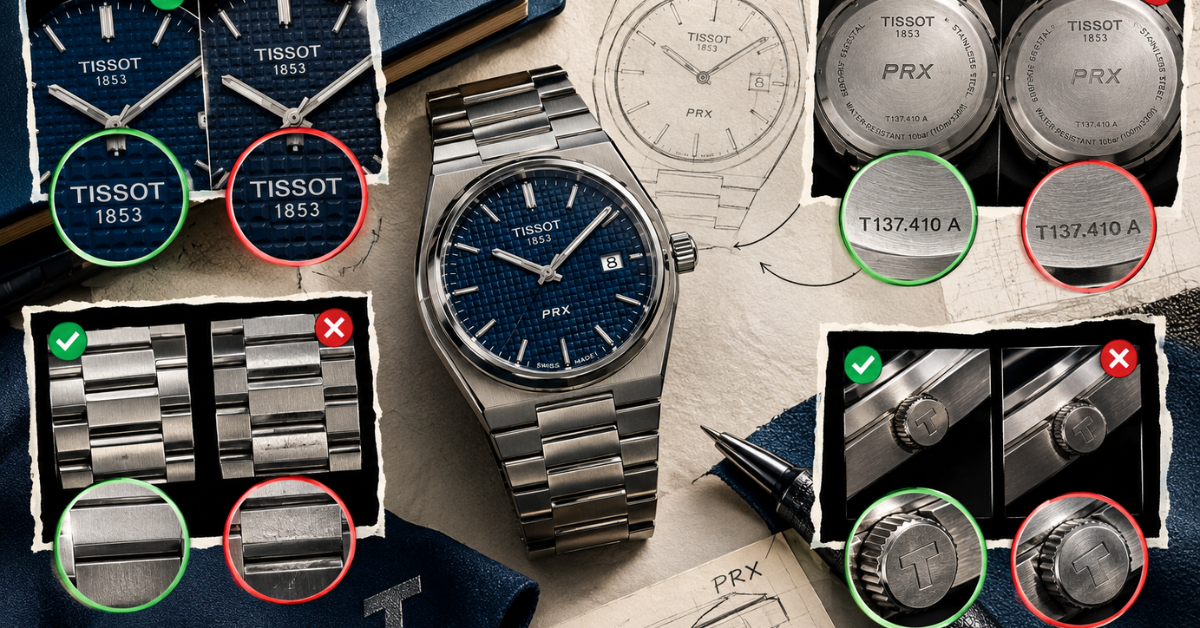
Every genuine PRX reference number encodes specific details about the watch — the T137.407 prefix, for instance, corresponds to the 40mm Powermatic 80 automatic, with additional digits specifying dial color and bracelet type. If a seller's claimed reference number doesn't match the watch's actual case size, dial color, or movement type, that mismatch is a legitimate red flag worth investigating before you buy. Our PRX vs PRX Powermatic 80 comparison covers the real differences between reference families if you're trying to confirm which version a specific listing actually claims to be.
A Note on Price
Worth being direct about this: while the most obvious PRX fakes sell for $20 to $80 against a genuine retail price of roughly $375 to $750, some counterfeits sophisticated enough to fool casual inspection have reportedly been sold on marketplaces at full genuine retail price specifically to avoid raising suspicion. A price that looks reasonable doesn't replace the checks above — it just means the seller understood that an obviously cheap price is itself a red flag.
What These Checks Won't Guarantee
As with any authentication approach, no combination of checks provides absolute certainty against the most sophisticated counterfeits. These five catch the significant majority of PRX fakes in circulation, particularly the high-volume, lower-quality copies that make up most of what's actually sold as counterfeit PRX watches. For any purchase where real money is on the line, having the watch inspected by an authorized retailer or an experienced independent watchmaker remains the most reliable path to certainty.
FAQ
What's the fastest way to check if a Tissot PRX's dial is genuine? Tilt the watch under light and look at the waffle pattern — genuine dials show real physical depth and light play, while counterfeits often use a flat printed pattern with no shadow variation.
Can a fake PRX Powermatic 80 actually have a Powermatic 80 movement? No — documented cases show counterfeits fitting a Powermatic-style rotor onto an entirely different base movement, meaning the watch looks correct at a glance but the actual movement underneath doesn't match a genuine caliber.
Is a low price the best way to identify a fake PRX? Not entirely — while many fakes sell for a fraction of retail, some sophisticated counterfeits have been sold at full genuine price specifically to avoid the suspicion a too-good-to-be-true price would raise.
Does the PRX's bracelet reveal fakes easily? Yes — the seamless case-to-bracelet transition is difficult for counterfeiters to replicate well, and a visible gap or mismatched finishing at that junction is a strong sign of a fake.
Should I trust a PRX listing with a warranty card and matching serial number? Not automatically — documented cases show fakes sold with warranty cards showing serial numbers that appear to register correctly, so documentation alone isn't sufficient without also checking the physical and mechanical details.
Conclusion
The PRX's viral popularity is exactly what's made it such a heavily targeted counterfeit, and the checks that actually catch a fake go well beyond price alone — waffle dial depth, bracelet integration, and, for the automatic version, genuine movement verification. Documented cases show even careful buyers getting fooled by convincing fakes, which makes running through all five checks together, rather than trusting any single one, the safest approach before you buy.
Reviews Editor
Sofia Marchetti
Reviews editor focused on dive watches, chronographs and everyday wearability.