On this page
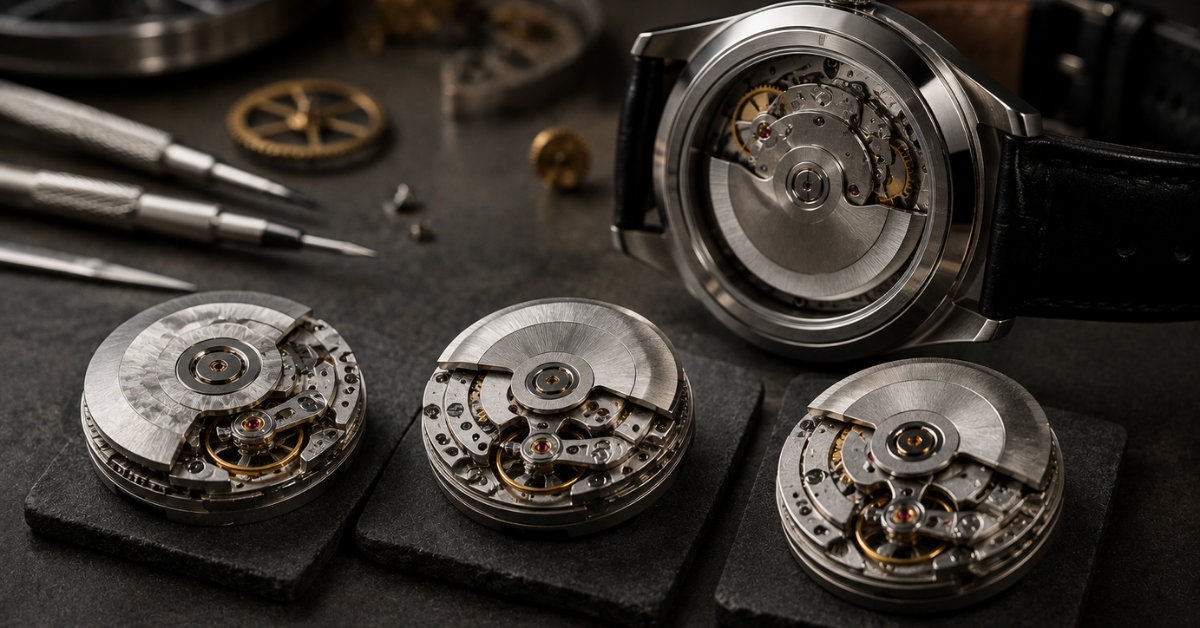
Tissot's automatic watches run on three distinct movement families. Standard ETA calibers (like the 2824-2) are the traditional Swiss workhorse architecture used industry-wide, offering roughly 38 hours of power reserve at a smooth 28,800 vibrations per hour. Powermatic 80, Tissot's signature automatic platform since 2012, extends power reserve to 80 hours by slowing the frequency to 21,600 vibrations per hour, and remains fully serviceable. Swissmatic, Tissot's budget automatic tier, offers a similar 72-hour reserve through heavy production automation, but is built as a non-serviceable, sealed module — the single biggest practical difference between it and the Powermatic 80.
"Automatic Tissot" isn't one specification — it's three genuinely different engineering approaches, and the movement name printed on the case back or listed in the spec sheet changes what you should actually expect from long-term ownership, not just the marketing copy. This breaks down what each one actually is, honestly, including the trade-off most listings don't mention.
Standard ETA: The Industry Foundation
ETA is the Swatch Group's movement manufacturing arm, and its standard calibers — the 2824-2 being the most widely referenced — form the architectural foundation that a huge share of accessible Swiss automatic watchmaking is built on, Tissot included. A standard ETA automatic runs at 28,800 vibrations per hour (4 Hz), delivering a smooth, fluid second-hand sweep and roughly 38 hours of power reserve when fully wound. It's fully serviceable by any qualified watchmaker, using well-understood, decades-proven architecture.
This is the baseline against which Tissot's own two branded movement families should be understood — both Powermatic 80 and Swissmatic are ETA-derived, built from this same underlying architecture but modified for different priorities.
Powermatic 80: Tissot's Signature Platform
Announced at Baselworld in 2012, the Powermatic 80 — based on the ETA C07.111 caliber — became Tissot's answer to a specific limitation: most Swiss automatics in its price range topped out around 36 to 38 hours of power reserve, meaning a watch left unworn over a long weekend would stop and need resetting. Powermatic 80 more than doubles that, delivering roughly 80 hours through a combination of a more efficient spring barrel and a reduced frequency of 21,600 vibrations per hour (3 Hz), down from the standard 28,800.
That frequency reduction is a genuine, honest trade-off worth understanding rather than glossing over: the second-hand sweep on a Powermatic 80 is visibly less smooth than a standard 4 Hz ETA movement or a comparable Sellita SW200 — a real, observable difference if you're used to higher-frequency automatics, not a manufacturing flaw. In exchange, you get more than double the power reserve. Neither choice is objectively better; it's a genuine engineering trade-off between smoothness and endurance.
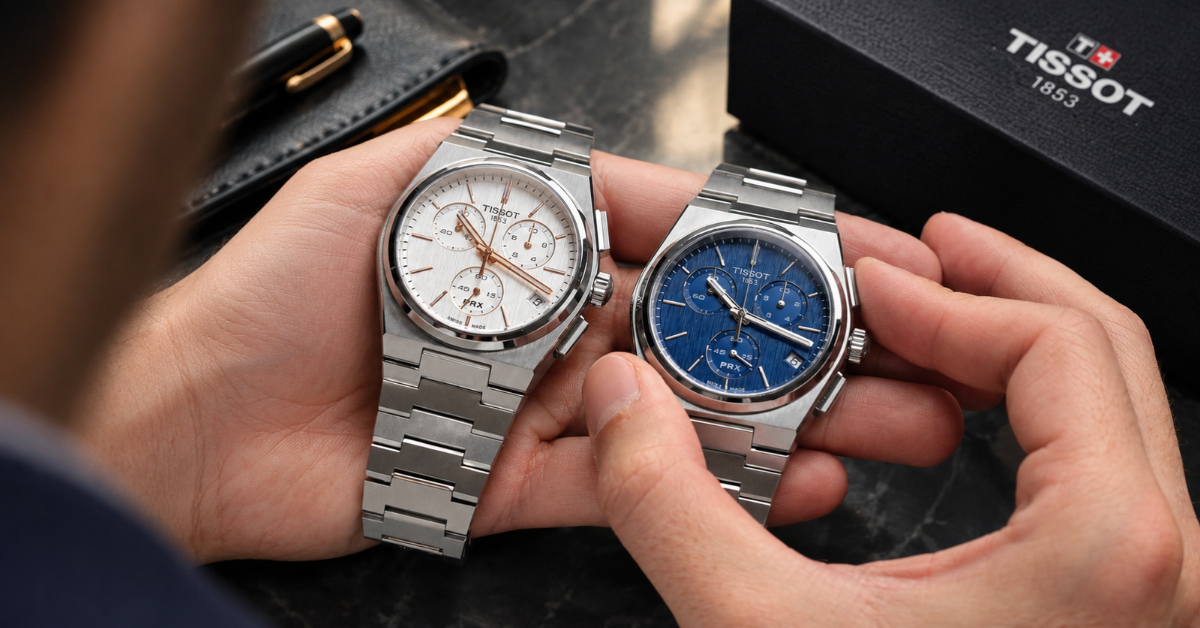
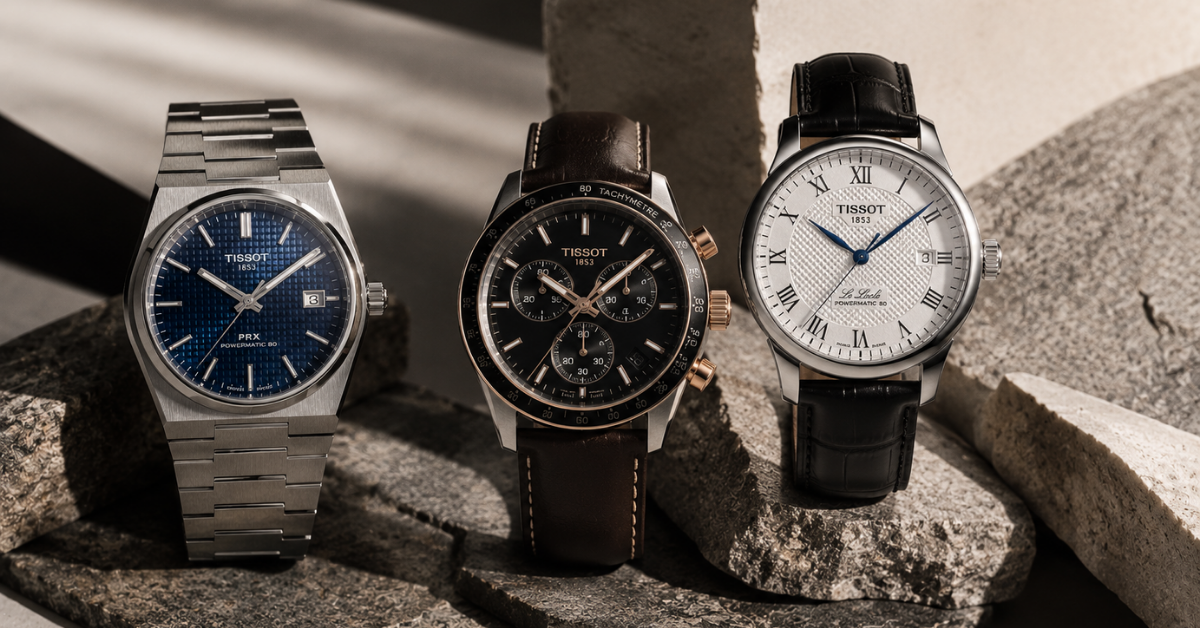
Powermatic 80 remains fully serviceable, carries 23 jewels, and is manufactured exclusively for Swatch Group's watchmaking brands — Tissot, Hamilton, Mido, Certina, and Rado. It's the movement inside the PRX Powermatic 80 and the Seastar 1000, among others. Our PRX vs PRX Powermatic 80 comparison covers how this movement performs in Tissot's most popular current model specifically, and our Seastar 1000 review covers it in a genuine dive-watch context.
Swissmatic: The Budget Automatic — and the Detail That Actually Matters
This is where things get genuinely confusing for buyers, because on paper, Swissmatic looks close to Powermatic 80. Built on the ETA C15.111 caliber, it also runs at 21,600 vibrations per hour and offers an impressive 72-hour power reserve — close enough to Powermatic 80's 80 hours that the difference barely registers day to day.
The real distinction isn't in the spec sheet at all — it's in how the movement is built and, critically, how it's serviced. Swissmatic is manufactured on heavily automated production lines specifically to reduce per-unit cost, using simpler regulation and lower-grade finishing than Powermatic 80. But the detail that actually matters for ownership is this: Swissmatic is designed as a non-serviceable, sealed module. When it eventually wears out, typically after 10 to 15 years, the standard approach isn't disassembly, cleaning, and reassembly the way Tissot services a Powermatic 80 — it's replacing the entire movement module.
That's a meaningful departure from the servicing approach we've covered for Tissot's automatics generally. Our Tissot maintenance guide covers Tissot's standard 3-to-5-year servicing recommendation, which applies to serviceable movements like Powermatic 80 — Swissmatic-equipped watches follow a genuinely different long-term ownership model, and it's worth knowing which one you own before assuming the same service expectations apply.
The Three, Side by Side
- Standard ETA — roughly 38-hour power reserve, smooth 28,800 vph sweep, fully serviceable, the traditional baseline architecture.
- Powermatic 80 — roughly 80-hour power reserve, a visibly less smooth 21,600 vph sweep, fully serviceable, Tissot's signature mid-tier and premium automatic platform.
- Swissmatic — roughly 72-hour power reserve, similar 21,600 vph sweep to Powermatic 80, non-serviceable sealed module design, Tissot's most accessible automatic tier.
Which One Should Actually Influence Your Buying Decision
If long-term serviceability matters to you — the ability to have a trusted watchmaker maintain the same movement for decades — Powermatic 80 or a standard ETA-based model are the choices that support that, not Swissmatic. If you're buying at the most accessible end of Tissot's automatic lineup and comfortable with a "replace rather than repair" approach a decade or more down the line, Swissmatic's lower price reflects a genuine, reasonable trade-off rather than a corner cut for no reason.
For a broader sense of where each movement family typically shows up across Tissot's collections and what that means for pricing, our Tissot Price Guide breaks down cost by line, and movement family is one of the biggest drivers of where a given watch lands in that range.
Buying With Confidence
Whichever movement family you're shopping for, checking the specific caliber against what a listing claims is worth doing before you buy, particularly on the secondary market. Our guide on authenticating a Tissot against "Swiss Made" fakes covers how to verify what's actually inside a watch you're considering, movement included.
FAQ
What's the real difference between Powermatic 80 and Swissmatic? Beyond a small power reserve difference (80 hours versus 72), the meaningful distinction is serviceability — Powermatic 80 is fully serviceable by a watchmaker, while Swissmatic is a sealed, non-serviceable module designed to be replaced entirely when it eventually wears out.
Why does Powermatic 80 have a less smooth second-hand sweep than some other automatics? Its 80-hour power reserve is achieved partly by reducing the movement's frequency to 21,600 vibrations per hour, down from the more common 28,800, which produces a visibly less fluid sweep in exchange for significantly longer running time unworn.
Is Swissmatic a lower-quality movement than Powermatic 80? It uses simpler regulation and lower-grade finishing to reduce production cost, but it's a genuinely engineered movement offering a comparable power reserve — the real trade-off is long-term serviceability, not day-to-day performance.
Can a Swissmatic movement be repaired if something goes wrong? Generally, no in the traditional sense — Swissmatic is designed as a sealed module, so a failure typically means module replacement rather than the disassembly-and-repair process used for serviceable movements like Powermatic 80.
Which Tissot movement should I choose if I want to keep the watch for decades? Powermatic 80 or a standard ETA-based movement, since both support traditional servicing by a qualified watchmaker indefinitely, unlike Swissmatic's replace-rather-than-repair design.
Conclusion
"ETA," "Swissmatic," and "Powermatic 80" aren't just branding on a spec sheet — they represent three genuinely different answers to the same engineering question, each with a real trade-off attached. Powermatic 80 trades sweep smoothness for power reserve while staying fully serviceable. Swissmatic trades long-term serviceability for a lower price point at a similar reserve. Standard ETA keeps the traditional smooth sweep and shorter reserve. None of them is a wrong choice — the right one just depends on what you're actually optimizing for.
Editor-in-Chief
Editorial Team
The TissotWatches.blog editorial desk — independent watch journalism, reviews and buying advice.