On this page
- The PRX Chronograph Finally Gets Affordable
- The Two Watches at a Glance
- PRX Quartz Chronograph
- PRX Automatic Chronograph
- Size and Comfort: The Quartz Wins Clearly
- Movement: Quartz Precision vs Mechanical Soul
- The Quartz: More Features Than You'd Expect
- The Automatic: The Real Mechanical Deal
- The Dial: Different Layouts, Different Character
- Price: Where the $1,625 Goes
- Quartz Isn't "Lesser" on the PRX
- Who Should Buy Which?
- Buy the PRX Quartz Chronograph If...
- Buy the PRX Automatic Chronograph If...
- Other Chronographs Worth Considering
- Buying Tips
- Frequently Asked Questions
- How much is the Tissot PRX Quartz Chronograph?
- What is the difference between the PRX quartz and automatic chronograph?
- Is the PRX Quartz Chronograph worth it?
- When was the PRX Quartz Chronograph released?
- What movement is in the PRX Quartz Chronograph?
- Does the PRX Quartz Chronograph have a display caseback?
- The Bottom Line
The PRX Chronograph Finally Gets Affordable
The Tissot PRX is the watch that made integrated-bracelet style affordable. For a few hundred dollars, you get the angular 1970s case and flowing bracelet that usually cost five figures.
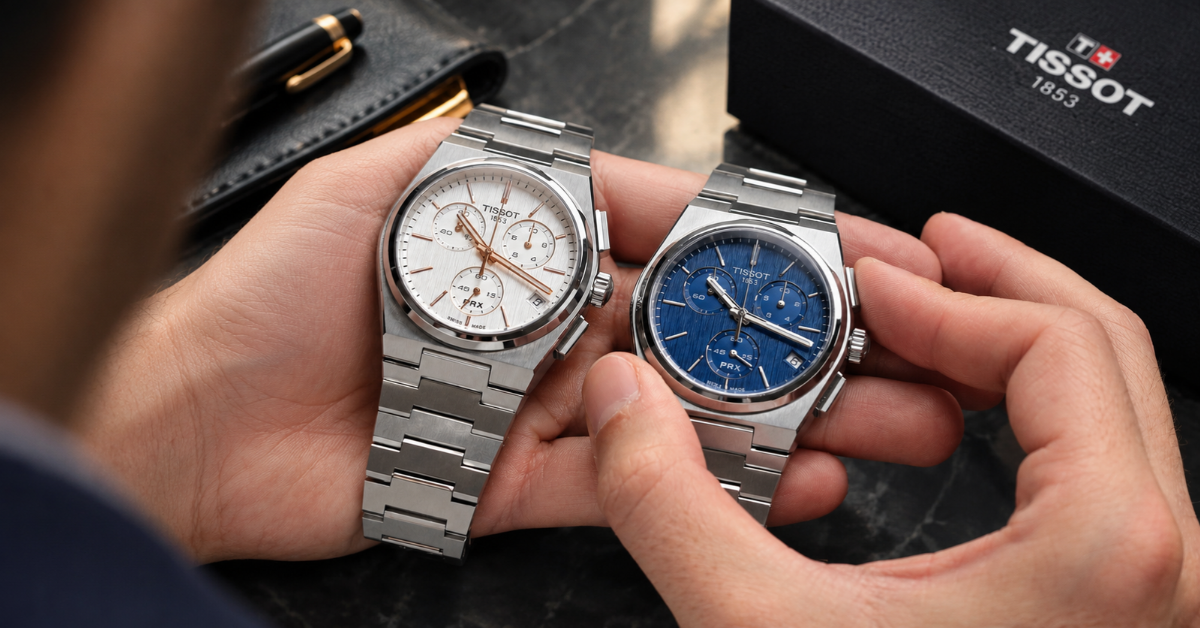
When Tissot added a chronograph in 2022, though, it broke that formula. The PRX Automatic Chronograph was a great watch, but at 42mm, nearly 15mm thick and over $2,000, it felt like a different product from the PRX everyone fell in love with.
On September 14, 2026, Tissot fixed that. The PRX Quartz Chronograph arrived at $525: slimmer, smaller and packed with timing features the automatic doesn't have. Which raises the obvious question: is the automatic still worth an extra $1,625? Let's compare them properly.
The Two Watches at a Glance
PRX Quartz Chronograph
- Price: $525 (US), £430 (UK)
- Case: 41mm 316L stainless steel, 11.65mm thick
- Movement: Swiss quartz chronograph, ETA G10.212 PowerDrive
- Chronograph: central 60-second hand, 30-minute and 1/10-second counters, ADD and SPLIT
- Extras: date at 4 o'clock, battery end-of-life indicator
- Crystal: sapphire
- Caseback: solid steel
- Water resistance: 100m
- Dials: blue, black or silver, vertically brushed
- References: T137.417.11.041.00 (blue), T137.417.11.051.00 (black), T137.417.11.031.00 (silver)
PRX Automatic Chronograph
- Price: $2,150 (US)
- Case: 42mm 316L stainless steel, 14.54mm thick
- Movement: automatic ETA Valjoux A05.H31
- Power reserve: 60 hours
- Chronograph: 30-minute and 12-hour counters, small seconds
- Crystal: sapphire
- Caseback: see-through, showing the movement
- Water resistance: 100m
Both share the PRX's integrated design, quick-release bracelet, Super-LumiNova on the hands and 100m water resistance.
Size and Comfort: The Quartz Wins Clearly
This is the biggest practical difference, and it's not close.
The automatic is 42mm wide and 14.54mm thick. That's chunky for a PRX, mainly because a mechanical chronograph movement takes up a lot of room. On smaller wrists, it can feel tall and top-heavy, and it doesn't slip easily under a shirt cuff.
The quartz is 41mm and just 11.65mm thick, almost 3mm slimmer. That's a huge difference on the wrist. It sits closer to the feel of the regular PRX, which is exactly what made the collection so wearable in the first place.
If you're unsure which PRX size suits you generally, read what size Tissot PRX you should actually buy.
Movement: Quartz Precision vs Mechanical Soul
The Quartz: More Features Than You'd Expect
The PRX Quartz Chronograph uses the ETA G10.212 PowerDrive movement. It's surprisingly capable:
- 1/10-second timing, more precise than the automatic
- ADD function: stop and restart the chronograph without resetting it, so you can add up separate periods of time
- SPLIT function: check an interim time while the chronograph keeps running
- Battery end-of-life indicator, which warns you before the battery dies
"PowerDrive" also means the chronograph hands reset quickly and smoothly, rather than ticking awkwardly back to zero. And as a quartz watch, it's more accurate than any mechanical movement, needs no winding and costs little to maintain.
The Automatic: The Real Mechanical Deal
The PRX Automatic Chronograph uses the ETA Valjoux A05.H31, a modern relative of the famous Valjoux 7750 family. It beats at 4Hz with a 60-hour power reserve, and it's one of the best automatic chronograph movements at this price.
You can watch it work through the display caseback, with its skeletonised rotor. That's a big part of its appeal. One quirk worth knowing: some owners note the date can't be set with the crown, and instead needs a small pin pushed into a corrector on the case side.
For a wider look at how Tissot's movements compare, read Tissot movements explained.
The Dial: Different Layouts, Different Character
The two watches don't share a dial layout. The automatic has a classic three-register chronograph: 30-minute counter at 3 o'clock, 12-hour counter at 6 and small seconds at 9.
The quartz gets its own arrangement, with a date window at 4 o'clock and vertically brushed dials in blue, black or silver. Some purists dislike the 4 o'clock date, but it gives the quartz its own identity rather than making it a cheaper copy of the automatic.
Price: Where the $1,625 Goes
- PRX Quartz Chronograph: $525
- PRX Automatic Chronograph: $2,150
- Difference: $1,625
The quartz costs less than a quarter of the automatic. It's also only $75 more than the standard three-hand quartz PRX at $450, so you're getting a full chronograph for very little extra.
So what does the extra $1,625 buy with the automatic? A mechanical movement, a display caseback and the satisfaction of a watch that runs on springs and gears rather than a battery. That's it. In size, comfort and timing features, the quartz is actually the better watch.
Before you think of either as an investment, note that most Tissots lose value when resold. Our analysis of whether a Tissot is a good investment explains why. Buy whichever one you'll enjoy wearing.
Quartz Isn't "Lesser" on the PRX
Some buyers see quartz as the budget option. On the PRX, that's not quite fair.
The original PRX from 1978 was a quartz watch, and the modern collection relaunched in 2021 with quartz models first. A quartz PRX chronograph is arguably closer to the watch's roots than the automatic. We covered the quartz versus automatic debate for the three-hand PRX in Tissot PRX vs PRX Powermatic 80, and many of the same arguments apply here.
Who Should Buy Which?
Buy the PRX Quartz Chronograph If...
- You want the PRX look with chronograph style for $525
- You prefer a slimmer, more comfortable watch
- You'll actually use the timer, with 1/10-second, ADD and SPLIT functions
- You want low maintenance and grab-and-go reliability
Buy the PRX Automatic Chronograph If...
- A mechanical movement matters to you
- You love watching the movement through the caseback
- You have a larger wrist and like a substantial watch
- You see it as a step up toward more serious mechanical watches
Our verdict: for most people, the quartz is the better buy and the better-wearing watch. The automatic is for enthusiasts who specifically want mechanics, and for them it's still a very good watch at its price.
Other Chronographs Worth Considering
If you like the idea of a Tissot quartz chronograph but not the PRX design, there are good alternatives. The PRC 200 is a sportier, more traditional chronograph. Read our Tissot PRC 200 review. And for a basketball-themed option with the same ADD and SPLIT functions, see the Tissot Supersport NBA Chronograph.
If you've decided you'd rather have a mechanical watch at a lower price than the automatic chronograph, a Powermatic 80 three-hander is the sweet spot. Here's why so many people start with Tissot for their first automatic.
Buying Tips
The PRX is one of the most faked affordable Swiss watches, and a new release attracts copies fast. Buy from Tissot or an authorised retailer. If you're buying from a private seller, read 5 ways to verify a Tissot before buying privately, then run through how to verify your Tissot is genuine when it arrives.
Frequently Asked Questions
How much is the Tissot PRX Quartz Chronograph?
The Tissot PRX Quartz Chronograph costs $525 in the US and £430 in the UK. It's available in blue, black and silver dials on a stainless steel bracelet.
What is the difference between the PRX quartz and automatic chronograph?
The quartz version is 41mm and 11.65mm thick, uses the ETA G10.212 quartz movement with 1/10-second, ADD and SPLIT functions, and costs $525. The automatic is 42mm and 14.54mm thick, uses the Valjoux A05.H31 with 60 hours of power reserve and a display caseback, and costs $2,150.
Is the PRX Quartz Chronograph worth it?
Yes, for most buyers. At $525, it offers the PRX's integrated design, a sapphire crystal, 100m water resistance and a capable chronograph in a slimmer case than the automatic.
When was the PRX Quartz Chronograph released?
Tissot announced the PRX Quartz Chronograph on September 14, 2026. It joins the PRX Automatic Chronograph, which launched in 2022.
What movement is in the PRX Quartz Chronograph?
It uses the Swiss ETA G10.212 PowerDrive quartz chronograph movement, with a central 60-second chronograph hand, 30-minute and 1/10-second counters, ADD and SPLIT functions, a date and a battery end-of-life indicator.
Does the PRX Quartz Chronograph have a display caseback?
No. The quartz version has a solid steel caseback. Only the automatic PRX Chronograph has a see-through caseback showing its movement.
The Bottom Line
Save the $1,625? For most people, yes. The PRX Quartz Chronograph is slimmer, more comfortable, more precise and a quarter of the price. It's the PRX chronograph that finally feels like a PRX.
The automatic is still a lovely watch for those who want gears and springs on their wrist. But if you just want a great-looking chronograph you'll wear every day, the quartz is the one to buy.
Senior Writer
James Whitfield
Senior watch writer with a decade covering Swiss horology, vintage markets and modern releases.