On this page
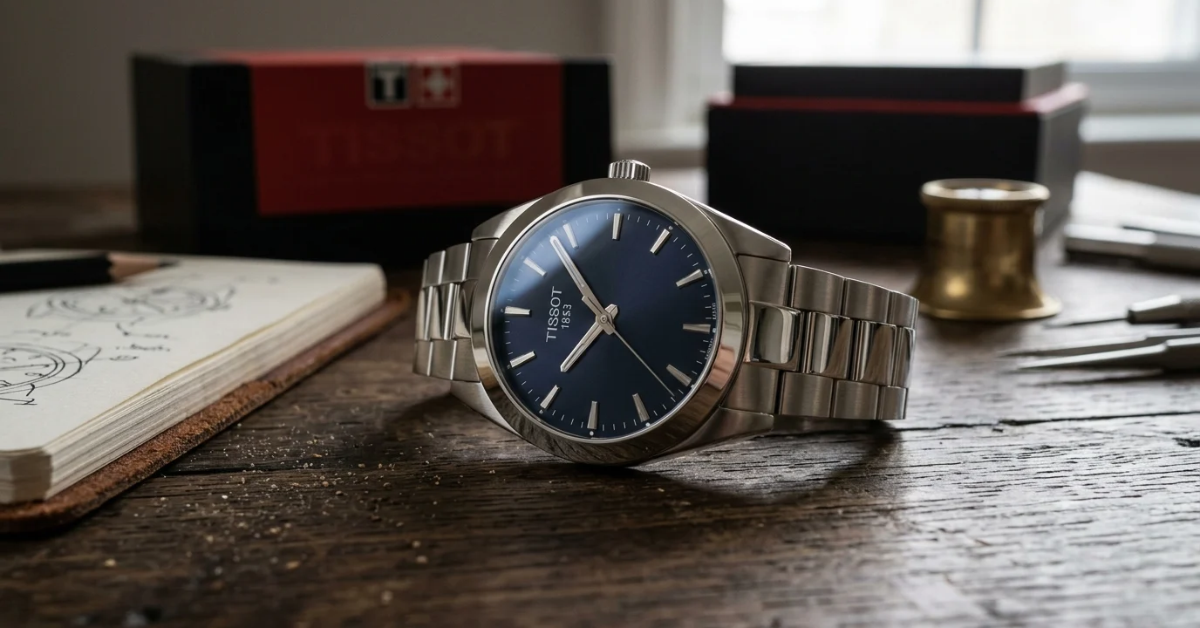
Most advice about fake watches is aimed at people deciding whether to buy. This is for the moment after you've bought, when the package is on your desk and you're about to put the watch on and head out. That's the point when you still have the most options. Once you've worn it to dinner, scratched the clasp and let the return window slip by, a bad surprise gets a lot more expensive.
None of the five steps below needs special tools. All of them can be done the day it arrives.
Before You Start: Protect Your Options
Return windows vary by seller and platform, and some private sellers accept no returns at all. Read the policy the day the watch arrives, not the week after. Then:
- Photograph the unboxing, including the packaging, the watch as it came, and anything inside the box.
- Leave protective film and tags on until you're satisfied.
- Keep it indoors. A watch you've worn outside is harder to return and harder to resell.
Step 1: Read the Caseback
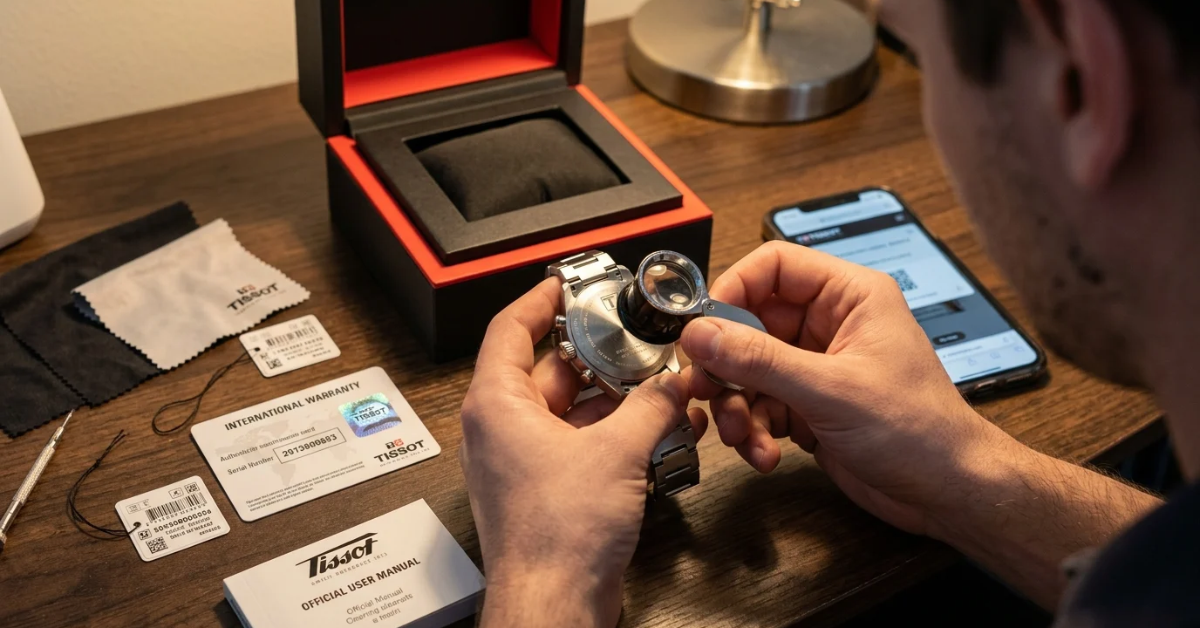
Turn the watch over. On any Tissot made since 2014, the caseback should carry a Watch-Secure code, a nine-character alphanumeric code engraved beside a small "WS" logo. Write it down exactly. Note the reference number too, which is usually a string like T137.407.11.041.00, and confirm it matches the model you thought you were buying. A mismatch between the listing and the reference on the caseback is the quickest red flag there is.
Watches made before 2014 won't have a WS code. For those, our guide to verifying a Tissot before buying from a private seller covers the different checks that apply.
Step 2: Register It on Tissot's Site
This is the strongest check available to a buyer, and it takes a few minutes. According to Tissot's own FAQ, the process is:
- Go to the "Register my watch" section of Tissot's official website for your region.
- Click "Register my watch."
- Identify the watch using the Watch-Secure number engraved on the caseback, or the RFID number on the watch label.
- Confirm the details by adding the watch to your collection.
- Log in to your Tissot account, or create one, to see your watch and warranty information.
Tissot states that the WS system, in place since 2014, identifies watches and allows their warranty to be activated through the website. If the system recognizes the number, that's a strong sign the watch is genuine. If the number isn't recognized, or the digital warranty doesn't show as active, Tissot's FAQ tells you to contact its Customer Service team.
A few honest caveats. Registration confirms the code is real, not that this particular watch belongs to it. A code that's already registered to someone else may simply mean the watch is legitimately pre-owned, so ask the seller what happened. And the check only works on the official Tissot site, so avoid third-party "verification" pages that ask for the code.
Step 3: Match the Numbers and Paperwork
Compare the WS code on the caseback with the RFID number on the watch label or the "Register my watch" card, and with any warranty documents. They should agree.One regional detail matters here. All Tissot watches carry a two-year international warranty, with three years for COSC-certified and Lightmaster Solar models, but in some markets Tissot doesn't issue a paper warranty card at all, and the warranty lives in your online account instead. So a missing paper card isn't automatically suspicious. A card whose numbers don't match the watch absolutely is.
Step 4: Give It a Physical Once-Over
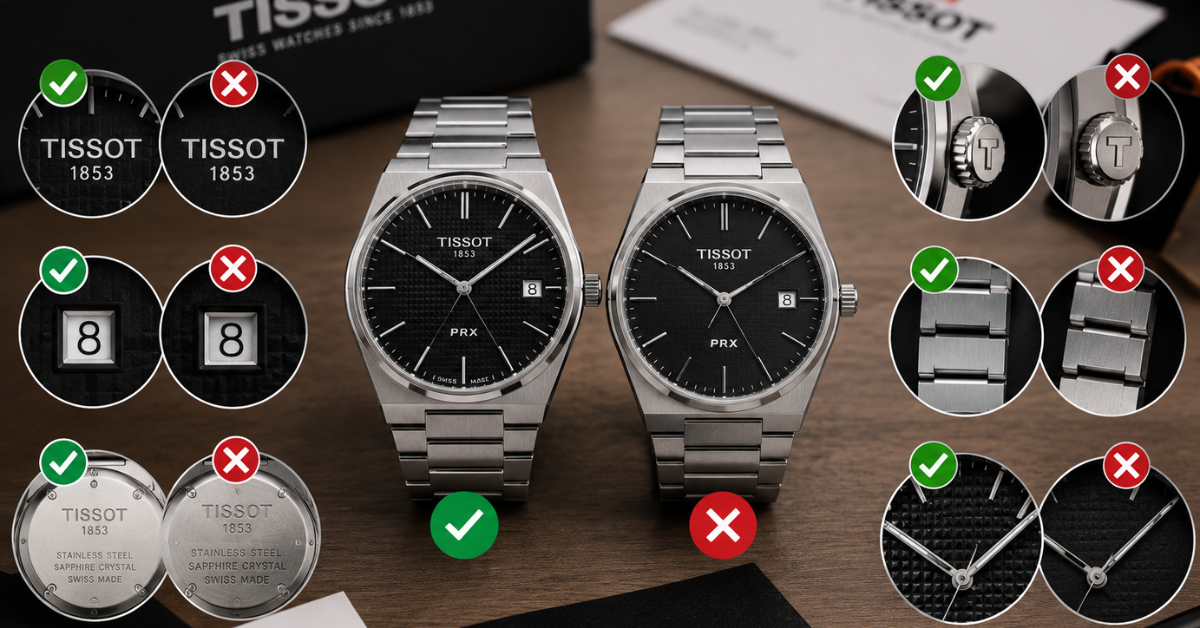
You don't need to do everything by hand when the work has been done already. Our general guide to authenticating a Tissot covers dial printing, caseback engraving depth and movement clues, and our guide to spotting a fake PRX goes further if that's what you bought.
Two reminders:
- "Swiss Made" on the dial proves nothing. It's printed text a fake can copy, as we explain in what Swiss Made actually means.
- The listing context counts. If the sale had any of the warning signs in our piece on seven signs your Tissot might be a fake, weigh that alongside what you find now.
Step 5: Run It for 48 Hours, Indoors
A real Tissot should behave like one, and you can check that without leaving the house.
- Set the time and date, then watch the midnight changeover. The date should advance cleanly.
- Test the controls. Crown positions should click firmly. On chronographs, pushers should respond precisely and the hands should reset to zero.
- Compare it to an accurate time source (a phone synced to network time works) at the start and end of the 48 hours. On a quartz PRX, Tissot's movement is accurate to roughly 10 seconds a month, so noticeable drift within two days would be odd. On an automatic, a few seconds of drift a day is unremarkable, but a watch gaining or losing minutes should prompt questions.
- Check the battery indicator on quartz models. A watch with a second hand jumping in two-second steps is signaling a weak battery, which our maintenance guide explains. On a supposedly new watch, that's worth asking the seller about.
- For a Powermatic 80, test the power reserve. Wear it for a day, then rest it. Our Powermatic 80 explainer covers why it should comfortably survive a weekend off the wrist. If it stops overnight, either it needs servicing or it isn't the movement you were sold.
Don't test water resistance by dunking it. Gaskets age, and a pre-owned watch's rating isn't guaranteed. If you plan to swim, have it pressure-tested first.
If Something Doesn't Add Up
- Stop wearing it. This keeps your return and dispute options intact.
- Document the problem with clear photos of the caseback, code, dial and any mismatch.
- Contact the seller or platform immediately, within the window they allow.
- Contact Tissot's customer service with the WS number and photos. Tissot's FAQ specifically directs buyers whose numbers aren't recognized to do this.
- Take it to an authorized service center for a definitive opinion. Don't open the caseback yourself.
What a Pass Does and Doesn't Mean
A watch that registers successfully, matches its paperwork, looks right and runs properly has cleared the main hurdles. No consumer checklist is bulletproof, though, and for an expensive piece it's worth having an authorized retailer or service center confirm. Our piece on first-time Tissot buyer mistakes covers why skipping this step is one of the most common regrets.
FAQ
How do I check if my Tissot is real? Find the nine-character Watch-Secure code on the caseback and try to register it on Tissot's official "Register my watch" page. If the system recognizes it, that's a strong sign of authenticity.
What is the Watch-Secure code? A nine-character alphanumeric code engraved on the caseback of Tissot watches made since 2014, used to identify the watch and activate its warranty online.
What if my Tissot's code isn't recognized? Tissot's FAQ says to contact its Customer Service team. Also stop wearing the watch and contact the seller while your return window is open.
Does a missing warranty card mean my Tissot is fake? Not necessarily. In some markets Tissot doesn't issue a paper card and keeps warranty details in an online account. A card with numbers that don't match the watch is the real concern.
How long is a Tissot warranty? Two years internationally, or three years for COSC-certified and Lightmaster Solar models.
Should I test my Tissot's water resistance in a sink? No. Gaskets age, and a pre-owned watch's rating isn't guaranteed. Have it pressure-tested if you plan to swim.
Conclusion
Verifying a watch takes about as long as unboxing it. Read the caseback, register the code, match the numbers, give it a once-over and let it run for a couple of days. If everything checks out, wear it with confidence. If something doesn't, you'll be glad you found out while you could still do something about it.
Senior Writer
James Whitfield
Senior watch writer with a decade covering Swiss horology, vintage markets and modern releases.