On this page
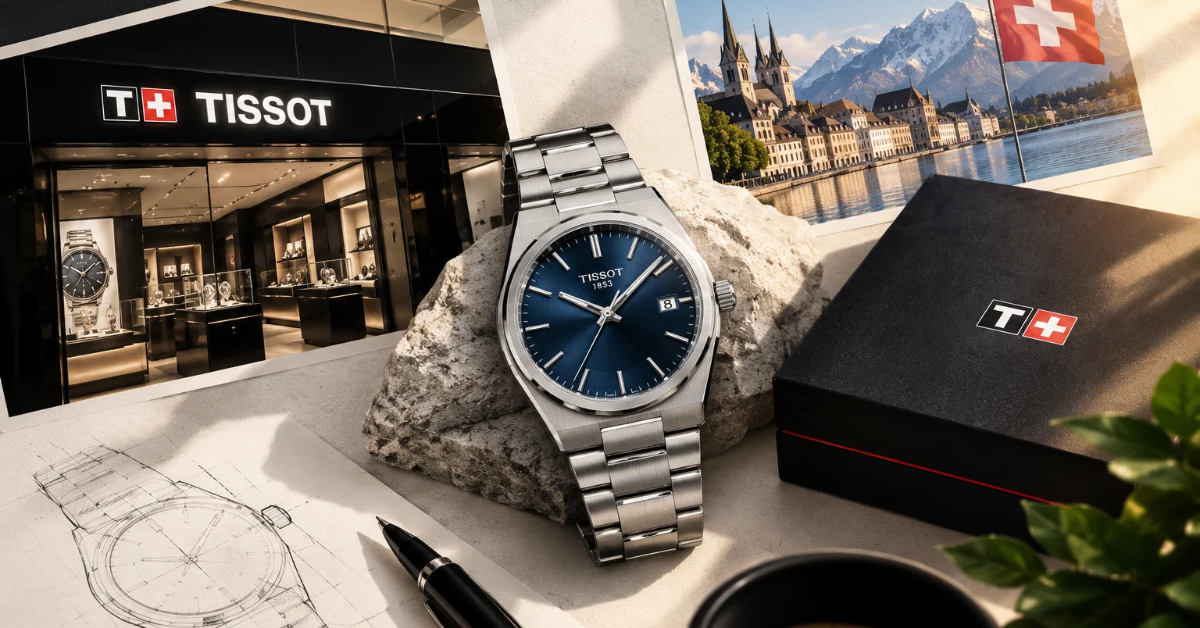
Ask five watch enthusiasts whether Tissot is a luxury brand and you'll get five answers, mostly because "luxury" means something different to each of them. The more useful question is what evidence you'd use to decide, and whether the answer changes how you should shop.
The word "still" in the title assumes Tissot has slipped. The evidence points the other way: its position has stayed steady for years. It's the best-known accessible Swiss brand, not a fallen luxury house.
What Tissot's Own Parent Company Says
The most direct evidence is how the Swatch Group sorts its brands. According to the group's published tiers, the Prestige and Luxury range includes Breguet, Harry Winston, Blancpain, Glashütte Original, Léon Hatot, Jaquet Droz and Omega. The high range holds Longines, Rado and Union Glashütte. Tissot sits in the middle range, together with Calvin Klein, Certina, Mido, Hamilton and Balmain.
Financial coverage describes it in similar terms. A company profile of the group calls Tissot the leader in midrange Swiss watches and lists it among Swatch Group's biggest brands. The same grouping shows up in tier lists dating back to at least 2017, so this isn't a recent demotion. Tissot is a volume brand, and the group's own structure doesn't ask it to be a luxury one.
What the Prices Say
Tissot's catalog runs from roughly $150 for an entry quartz watch to a few thousand dollars for its most elaborate pieces, and tracking data puts the brand's average price near $400. Our Tissot price guide breaks down where each collection lands.
There's no universal price line for luxury, but a brand whose typical watch costs a few hundred dollars isn't competing where the word is normally used. Tissot's own sibling brands show the gap: our comparison of Tissot and Hamilton shows two Swatch Group brands in nearly the same tier, while Omega sits several steps above both.
What Resale Says
Luxury brands tend to keep their value, and some appreciate. Tissot mostly doesn't. Our look at whether a Tissot is a good investment found most models lose meaningful value on resale, with the PRX Quartz losing more than half. Our piece on the fastest-depreciating Tissot explains why. Mass production and wide availability keep used prices low.
There are exceptions, and they're worth knowing. The T-Complication Squelette has tracked up in price over five years while the rest of the brand's index declined. A few Powermatic 80 references retain 85% to 95% of retail. But those are specific watches, not the brand.
What Tissot Does Well
None of this makes Tissot a lesser watchmaker. It makes it a different kind of one.
- Real Swiss manufacture. The "Swiss Made" label carries legal requirements, which we explain in what Swiss Made actually means, and Tissot meets them from its base in Le Locle.
- Serious movement technology for the price. The Powermatic 80's 80-hour reserve is a real engineering result, covered in Tissot Movements Explained.
- Pieces that stretch upward. The T-Complication pairs a respected hand-wound movement with a fully skeletonized design at around $2,000, and the Heritage 1938 carries independently certified COSC accuracy.
- Genuine firsts. Tissot made the first tactile watch in 1999, a piece of history unrelated to price.
Does the Label Matter?
Only if you want it to. "Accessible luxury" is a phrase brands and retailers use to bridge the gap, and Tissot is happy to benefit from it. But the more helpful frame is what you actually get for the money. Our comparison of the PRX Powermatic 80 and the Seiko 5 shows what a few hundred extra dollars buys: sapphire crystal, a longer power reserve, and a more refined case. That's a real step up from the entry level, without luxury prices.
If you want a watch that signals status, Tissot isn't built for that. If you want a well-made Swiss watch you won't hesitate to wear every day, it's one of the safest choices around.
FAQ
Is Tissot a luxury watch brand? Not by most measures. The Swatch Group places it in its middle range, and its watches typically cost $150 to $3,000.
Where does Tissot sit in the Swatch Group? In the middle range, alongside Certina, Mido, Hamilton and Balmain, below Longines and Rado in the high range and Omega in the prestige and luxury range.
Is Tissot better than Seiko? They compete at different points. Tissot generally costs more and offers Swiss manufacture and sapphire crystal, while Seiko offers strong value at lower prices.
Do Tissot watches hold their value? Mostly not. Many models lose a large share of their retail price, though a few references, such as the T-Complication, have held up.
Is Tissot good quality? Yes. It's a legitimate Swiss maker with serious movement technology for its price. Quality and luxury positioning are different things.
Conclusion
Tissot isn't a luxury brand, and it doesn't need to be one to be worth owning. Its parent company files it in the middle range, its prices and resale values back that up, and a few standout pieces reach higher. Judge it as what it is, the most recognized accessible Swiss watch brand, and it holds up very well.
Senior Writer
James Whitfield
Senior watch writer with a decade covering Swiss horology, vintage markets and modern releases.