On this page
The Tissot T-Complication Squelette is a fully skeletonized, hand-wound watch built around the ETA 6497-1 movement, visible through both a sapphire front and a see-through caseback, priced around $2,000. Worth clarifying upfront: "complication" here refers to visual and mechanical showcase complexity—a fully exposed, finished movement—not added functional complications like a chronograph or moonphase; the watch displays only hours, minutes, and power reserve. It's genuinely worth the price for buyers who want that showcase specifically, backed by real resale data showing it has outperformed both Tissot's own collection average and the broader watch market over the past five years.
"T-Complication" is a name that can mislead if you're not paying close attention, and it's worth clearing that up before anything else. This isn't a watch with an added function like a chronograph or annual calendar—it's a skeletonization showcase, built around making a genuinely respected movement fully visible rather than adding to what it does. Understanding that distinction is the actual key to answering whether it's worth the price.
What "Complication" Actually Means Here
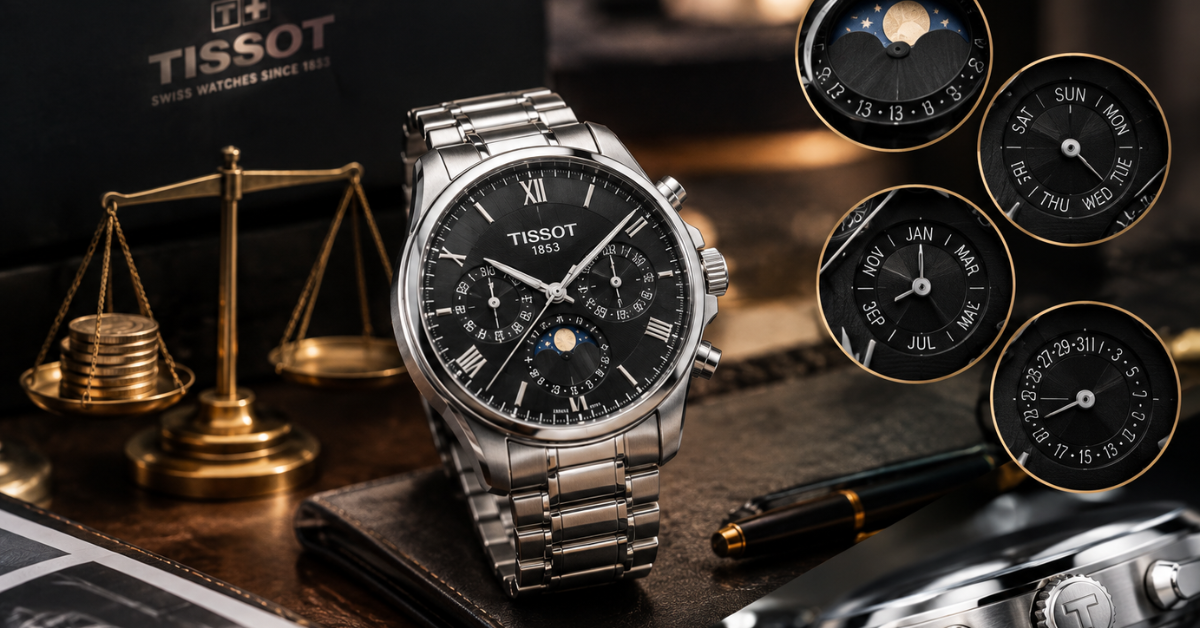
The flagship model, the T-Complication Squelette, displays only hours, minutes, and a power reserve indicator—no date window, no chronograph, no moon phase. The "complication" in the name refers to the mechanical and visual complexity of a fully skeletonized display, front and back, rather than genuine added functionality. If you're specifically shopping for a Tissot with a traditional horological complication—a chronograph, GMT, or calendar function—this isn't that watch, and it's worth knowing that distinction before the name leads you to expect something different.
The Movement: ETA 6497-1, a Genuinely Respected Architecture
This is where the watch actually earns its case, and it's worth explaining why. The T-Complication Squelette runs the ETA 6497-1, a hand-wound movement with real pedigree—it's a widely used, well-regarded caliber across the watch industry, often chosen specifically as a base for skeletonized display pieces because its construction lends itself to that kind of full visual exposure. It delivers 46 hours of power reserve across 17 jewels, and because both the front dial and the caseback are sapphire with anti-reflective coating on both, the movement is genuinely visible from every angle, not just a small display window.
Independent reviewers who've spent real time with the watch have specifically praised the finishing quality here—fine grooves across every flat surface, tool marks that remain invisible even under significant magnification. That level of visible finishing effort matters more on a fully skeletonized watch than almost any other design, since there's nowhere for inconsistent work to hide.
Case and Build
The Squelette runs a 43 mm brushed stainless steel case at 11.99 mm thick, with hard-edged lugs contrasting against a rounded bezel—a genuine design choice, not an afterthought. The turbine-inspired skeleton dial layout incorporates blue, purple, and yellow tone accents against the exposed steel movement components, described by at least one independent reviewer as having more immediate visual impact than any other Tissot they'd covered, capable of drawing attention from people who don't otherwise follow watches closely. Water resistance sits at 50 meters, consistent with a piece built for showcase and occasion wear rather than daily rough use.
Pricing
The T-Complication Squelette carries an MSRP around $2,000, placing it toward the top of Tissot's standard catalog pricing alongside the brand's precious-metal Heritage pieces. Our Tissot Price Guide covers how that positions it relative to the rest of the catalog—this is a genuine step up from Tissot's Powermatic 80 and Swissmatic automatic tiers, both covered in more technical depth in our Movements. The explained guide, since the ETA 6497-1's hand-wound, fully finished architecture represents a genuinely different engineering commitment than either of those platforms.
The Data That Actually Makes the Case
This is worth taking seriously rather than treating as a nice-to-know footnote. Secondary-market tracking shows the T-Complication Squelette has meaningfully outperformed both Tissot's own T-Classic collection index and the broader overall watch market over the past five years—up roughly 12.1% in market price during a period when Tissot's own collection index declined by 2.4% and the wider market index declined by 2.5%. That's a genuinely notable divergence: while much of Tissot's catalog, and the watch market generally, has softened over that window, this specific watch has moved in the opposite direction.
It also sells relatively quickly once listed, with a median time on market faster than roughly 70% of comparably tracked watches—a real liquidity signal suggesting consistent buyer demand rather than a piece that sits unsold on the secondary market. Together, that's meaningful evidence this isn't a watch riding short-term hype; it's held genuine, sustained appeal.
So, Is the Extra Complexity Worth the Price?
Yes, for the buyer it's actually built for. If what you want is a genuine mechanical showcase—a fully visible, hand-finished movement built on real horological pedigree, in a design distinctive enough to draw attention from watch people and non-watch people alike—the T-Complication Squelette delivers that honestly, and the resale data backs up that it's not just marketing language. If what you actually want is a watch with more functional capability—a date, a chronograph, additional complications in the traditional sense—this specific piece won't deliver that regardless of its name, and you'd be better served elsewhere in Tissot's catalog, including the Heritage 1938, which pairs its own traditional movement credentials with genuine calendar functionality.
Caring for a Hand-Wound Skeleton Watch
Ownership here differs meaningfully from Tissot's automatic lineup—no rotor winding it as you wear it, meaning a daily winding habit via the crown. Our Tissot Maintenance Guide covers Tissot's general service recommendations, which apply to hand-wound movements like this one as much as to any automatic in the catalog.
Buying With Confidence
Given the price point and the watch's distinctive, recognizable design, buying from an authorized retailer removes any authentication risk. Tissot's own guidance specifically warns buyers to purchase through official channels to avoid counterfeit risk on pieces like this—our guide on authenticating a Tissot against "Swiss Made" fakes covers the fundamentals worth applying to any purchase.
FAQ
Does the Tissot T-Complication have a chronograph or calendar function? No—the flagship Squelette model displays only hours, minutes, and power reserve; "complication" here refers to its skeletonized visual and mechanical design, not added functional complications.
What movement does the T-Complication Squelette use? The ETA 6497-1, a hand-wound movement with 46 hours of power reserve and 17 jewels, is widely respected across the industry and commonly used as a base for skeletonized watches.
How much does the Tissot T-Complication cost? The Squelette carries an MSRP around $2,000, placing it near the top of Tissot's standard catalog pricing.
Does the T-Complication Squelette hold its value well? Yes, notably so—secondary-market tracking shows it up roughly 12.1% in price over five years, while Tissot's own collection index and the broader watch market both declined over the same period.
Is the T-Complication a good choice if I want a Tissot with more functions? No—since it offers no date, chronograph, or calendar complications, buyers wanting genuine added functionality are better served by another Tissot collection specifically built around those features.
Conclusion
The T-Complication Squelette earns its price through genuine mechanical showcase value—a respected hand-wound movement, fully exposed and finished to a standard independent reviewers have specifically praised, backed by resale data that's genuinely unusual for how much of the rest of Tissot's catalog has performed over the same period. Just go in understanding what "complication" means on this specific watch: visual and mechanical complexity, not added function. Once that expectation is set correctly, the price makes considerably more sense.
Senior Writer
James Whitfield
Senior watch writer with a decade covering Swiss horology, vintage markets and modern releases.