On this page
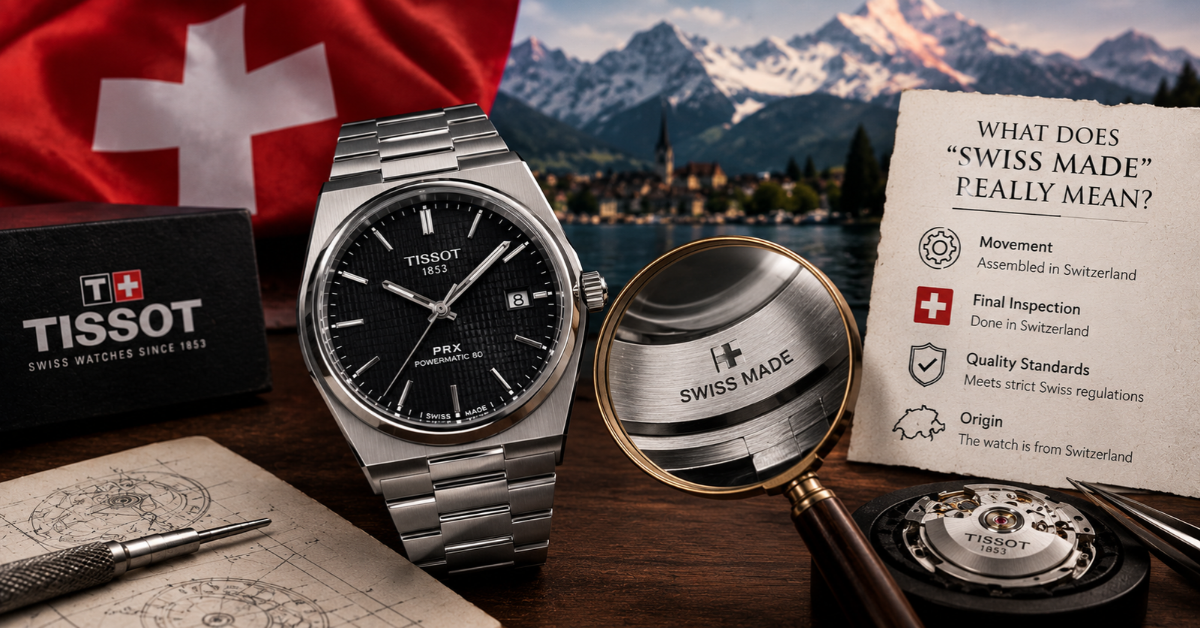
"Swiss Made" on a Tissot is a legal origin standard, not a quality grade. Since 2017, Swiss law has required that a watch's technical development happen in Switzerland, that its movement be Swiss, that the movement be cased up in Switzerland, that the manufacturer carry out the final inspection there, and that at least 60% of the whole watch's manufacturing costs be incurred in Switzerland. It does not mean every part is made there. The mark is also just printed text, so a counterfeit can carry it too, which is why it counts as one clue rather than proof.
Almost every Tissot dial carries the same two words, and most buyers read them as a promise without knowing what the promise covers. The rules behind it are specific, they changed in 2017, and they say less than people assume. This covers what the label requires, what it leaves out, and how it applies to a Tissot.
Where the Rule Comes From
The label is governed by the Ordinance on the Use of "Switzerland" or "Swiss" for Watches, a Federal Council ordinance that dates to 1971. Switzerland revised it, and the revision took effect on 1 January 2017, as part of the wider "Swissness" legislation. The Swiss Federal Institute of Intellectual Property, which administers the rules, describes the aim as strengthening the link between the "Swiss" indication and Switzerland itself. It is not a manufacturer's marketing claim or a Tissot invention. It is a legal standard that any brand using the words has to meet.
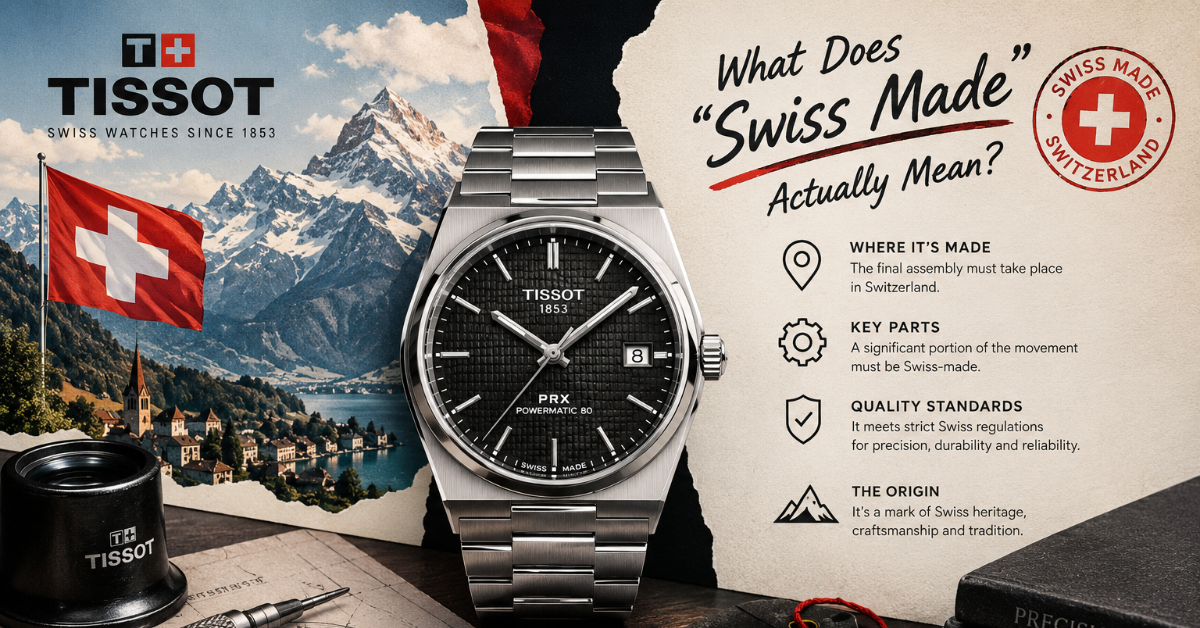
The Five Conditions
A watch can be called Swiss Made only if all of the following are true:
- Its technical development takes place in Switzerland.
- Its movement is Swiss.
- The movement is cased up in Switzerland.
- The manufacturer carries out the final inspection in Switzerland.
- At least 60% of the watch's manufacturing costs are incurred in Switzerland.
The movement has its own test. To count as Swiss, at least half the value of its components must be made in Switzerland, at least 60% of its manufacturing costs must be generated there, its technical development must happen there, and the manufacturer must inspect it in Switzerland.
The 2017 change is worth knowing. Before it, the cost test focused on the movement. Since then, the 60% figure covers the whole watch, which was meant to make the label harder to earn on a watch that was mostly made elsewhere.
What It Doesn't Mean
The label does not say every component is Swiss. It is a cost-based test, so up to 40% of a watch's manufacturing cost can legitimately be spent outside Switzerland, and the law measures a share of value rather than the origin of each part. Critics of the system have pointed out that a cost threshold leaves manufacturers real latitude in how they reach it.
It also isn't a quality grade. "Swiss Made" says where meaningful work happened, not how well it was done. Two watches can both carry it and differ widely in finishing and accuracy, which is why movement certifications and reputable service matter separately.
A related mark shows the distinction. "Swiss Movement" can appear on a watch whose movement is Swiss but which isn't cased up in Switzerland. It is a narrower claim, and it is not the same as "Swiss Made".
How It Applies to a Tissot
Tissot was founded in Le Locle in 1853 and is still based there, and our piece on Tissot's Le Locle heritage covers that history. Tissot also belongs to the Swatch Group, which makes its own movements in Switzerland. That is why the movement tests in the law are straightforward for the brand to satisfy in practice: the Powermatic 80, for example, is an ETA-derived movement built for Swatch Group brands, as we explain in our Powermatic 80 explainer and in Tissot Movements Explained.
Origin alone doesn't decide eligibility, either. Hamilton began as an American brand and is still sold as Swiss Made, because what counts is where development, movement, casing and inspection happen. Our Tissot vs Hamilton comparison covers how two Swatch Group siblings with different roots end up under the same rules.
On the watch itself, the words usually appear near 6 o'clock on the dial and are engraved on the caseback along with the other markings. If you're comparing what a genuine Tissot should show, our guide on authenticating a Tissot against "Swiss Made" fakes covers the details.
Why the Label Can't Prove Authenticity
This is the point that matters most for buyers. "Swiss Made" is printed text. A counterfeiter can add it to a dial at no cost, so its presence proves nothing about where a watch was really built. Tissot itself warns that too-good-to-be-true prices on marketplaces usually mean a fake.
The checks that actually carry weight are different ones: the Watch-Secure code registration described in our guide to verifying a Tissot before buying from a private seller, the physical inspection points in the PRX-specific guide to spotting a fake Tissot PRX, and the listing-level warning signs in 7 Signs Your Tissot Might Be a Fake. Treat the words on the dial as a starting point, not a certificate.
FAQ
Does "Swiss Made" mean every part of a Tissot is made in Switzerland? No. It means the watch meets a set of legal tests, including at least 60% of its manufacturing costs incurred in Switzerland, so some components can legitimately come from elsewhere.
What are the legal requirements for "Swiss Made" on a watch? Technical development in Switzerland, a Swiss movement, casing-up in Switzerland, final inspection by the manufacturer in Switzerland, and at least 60% of manufacturing costs incurred in Switzerland.
What changed in 2017? The revised ordinance took effect on 1 January 2017 and extended the 60% cost test from the movement to the whole watch.
Is "Swiss Made" a guarantee of quality? No. It is an origin standard. It says where meaningful production happened, not how well the watch is finished or how accurate it is.
Can a fake Tissot say "Swiss Made"? Yes, because the words are just printed on the dial and caseback. Use registration checks and physical inspection to confirm authenticity.
What is the difference between "Swiss Made" and "Swiss Movement"? "Swiss Movement" can be used when the movement is Swiss but the watch is not cased up in Switzerland, so it is a narrower claim.
Conclusion
"Swiss Made" is a real, legally defined standard, and a Tissot built by its parent group's Swiss supply chain sits comfortably within it. It tells you where the essential work happened. It does not tell you every part is Swiss, that the watch is well made, or that the one in front of you is genuine. Knowing that keeps the label useful and keeps it from being the only thing you check.
Senior Writer
James Whitfield
Senior watch writer with a decade covering Swiss horology, vintage markets and modern releases.