On this page
Tissot and Hamilton aren't really competitors in the traditional sense — both belong to the Swatch Group, share closely related ETA-derived automatic movement technology (Tissot's Powermatic 80 and Hamilton's H-10/H-40, both delivering roughly 80 hours of power reserve), and overlap heavily in price, generally $300 to $2,000 for most core models from either brand. The real difference is design heritage: Tissot is a purely Swiss watchmaker dating to 1853, while Hamilton is an American brand, founded in Lancaster, Pennsylvania in 1892, that moved its manufacturing to Switzerland in the 1960s and 70s. Value is close to a toss-up between them — the better pick depends on which design language and heritage story actually speaks to you.
"Tissot vs Hamilton" isn't quite the rivalry the framing suggests, and it's worth saying that plainly before comparing anything else: these two brands are corporate siblings, not competitors slugging it out for the same buyer from opposing camps. Both sit inside the Swatch Group, both draw on closely related movement technology, and both occupy nearly identical price territory. The real question isn't which one wins — it's which one's specific design heritage and collection lineup actually fits what you want to wear.
Same Corporate Family, Different Origin Stories
Tissot's history is straightforwardly Swiss from the beginning — founded in 1853 in Le Locle, in the heart of Switzerland's watchmaking region, with manufacturing that's remained there ever since. Our piece on Tissot's Le Locle heritage covers that history and what it actually means for the "Swiss Made" label on every Tissot dial.
Hamilton's story runs differently, and it's genuinely more interesting for it. Founded in 1892 in Lancaster, Pennsylvania, Hamilton built its early reputation as an American watchmaker, supplying precision timepieces to the US military and the American railroad industry — sectors where accuracy wasn't a preference but a functional necessity. That tool-watch DNA still runs through Hamilton's design language today, particularly in the Khaki Field line. In the 1960s, Hamilton acquired the Swiss-based Buren Watch Company and gradually shifted its manufacturing to Switzerland, a transition completed by 1974 when Hamilton became part of SSIH — the company that eventually evolved into today's Swatch Group. The result is a genuinely unusual brand identity: American military heritage, delivered through fully Swiss-made modern manufacturing.
The Movements Are More Related Than You'd Expect
This is the detail that actually matters most for a value comparison, and it's rarely explained clearly. Tissot's signature automatic platform, the Powermatic 80, and Hamilton's equivalent H-10 and H-40 calibers are both derived from the same underlying ETA architecture within the Swatch Group's movement-manufacturing arm. Both deliver roughly 80 hours of power reserve — more than double what a standard 38-hour automatic offers — through the same basic engineering approach of a more efficient spring barrel and reduced operating frequency.
If you want the deeper technical breakdown of how this movement family actually works, including the real trade-offs involved in reaching that 80-hour figure, our Tissot Movements Explained guide covers the mechanics in detail — nearly all of it applies directly to Hamilton's H-10 and H-40 calibers as well, since they're built on closely related foundations. Choosing between Tissot and Hamilton on movement technology alone is close to a wash; you're getting comparable engineering either way.
Pricing: Genuinely Overlapping Territory
Hamilton's overall lineup generally averages around $900, spanning roughly $200 for entry quartz pieces up to $4,000 for its more complicated automatics, with select gold limited editions climbing considerably higher still. The Khaki collection specifically, Hamilton's most popular line, averages around $800 and typically ranges from $200 to $2,000.
That maps closely onto Tissot's own pricing structure. Our Tissot Price Guide breaks down Tissot's tiers from roughly $150 entry quartz models up through $1,000-plus Powermatic 80 automatics and considerably more for Heritage precious-metal pieces — a nearly identical shape to Hamilton's own range. Neither brand has a meaningful price advantage over the other at a category level; the real pricing differences show up model-to-model, not brand-to-brand.
Where the Design Identities Actually Diverge
This is where the comparison gets genuinely useful, because the two brands pull in different aesthetic directions despite the shared engineering underneath.
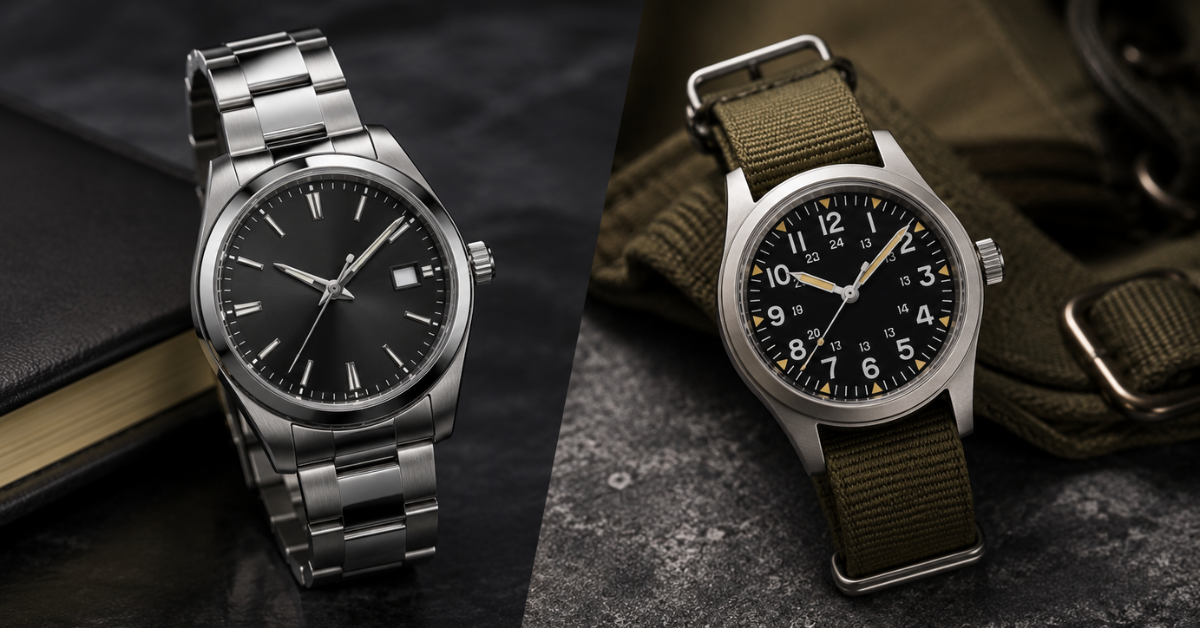
Hamilton leans hard into its tool-watch and military-aviation heritage. The Khaki Field line channels genuine field-watch functionality with oversized, legible dials and a straightforward, purposeful design language; the Khaki Aviation range draws directly on Hamilton's WWII-era cockpit clock heritage, with large Arabic numerals built for cockpit legibility. The Jazzmaster line covers Hamilton's dressier territory, including open-heart references that show the balance wheel through a dial window. The Ventura, with its distinctive triangular case, remains one of the more genuinely unusual silhouettes in accessible Swiss watchmaking.
Tissot's range is broader and less anchored to one origin story. The PRX channels 1970s integrated-bracelet sport-luxury design; the Seastar covers genuine dive-watch territory, reviewed in detail in our Seastar 1000 review; the Le Locle and Heritage lines cover classical dress watches tied directly to the brand's own hometown. Where Hamilton tends to feel like variations on a consistent American-tool-watch theme, Tissot spreads across more genuinely distinct design languages within one catalog.
So Which Actually Gives More Value?
Neither brand wins this outright, and pretending otherwise would be dishonest. Both deliver genuinely Swiss-made construction, comparable ETA-derived automatic movement technology with similar power reserves, and overlapping price tiers for broadly comparable quality. The real decision comes down to which design story you actually want on your wrist: Hamilton's American military and aviation heritage delivered through Swiss manufacturing, or Tissot's straightforwardly Swiss identity spread across a wider range of design directions.
If you're drawn to purposeful, legible field-watch design with genuine military lineage, Hamilton's Khaki line is difficult to beat at its price point. If you want more variety within one brand — dive watches, integrated-bracelet sport pieces, and classical dress watches all under one roof — Tissot's broader catalog makes a stronger case. Either way, you're buying into the same corporate movement-engineering ecosystem regardless of which nameplate ends up on the dial.
Buying With Confidence
Whichever brand you choose, buying from an authorized retailer removes any authentication risk. If you're specifically shopping Tissot and want to verify what you're buying, our guide on authenticating a Tissot against "Swiss Made" fakes covers the checks worth running before any purchase, new or pre-owned.
FAQ
Are Tissot and Hamilton made by the same company? Both are owned by the Swatch Group, though they operate as distinct brands with their own design identities, collections, and heritage stories.
Do Tissot and Hamilton use the same watch movements? They use closely related, ETA-derived movement architecture — Tissot's Powermatic 80 and Hamilton's H-10 and H-40 calibers share a similar underlying design and deliver comparable 80-hour power reserves.
Is Hamilton or Tissot more expensive? Their price ranges overlap heavily, both generally spanning $200 to $2,000 for most core models, with select higher-end pieces from either brand climbing considerably further.
Why is Hamilton considered an American brand if it's Swiss Made? Hamilton was founded in Lancaster, Pennsylvania in 1892 and built its early reputation on American military and railroad timepieces, but it moved manufacturing to Switzerland starting in the 1960s and has been fully Swiss Made since 1974.
Which brand has better watches for daily wear, Tissot or Hamilton? It depends on style preference rather than quality — Hamilton's Khaki Field line suits buyers who want purposeful, legible tool-watch design, while Tissot's broader catalog suits buyers who want more variety across dive, dress, and sport-luxury styles.
Conclusion
Tissot and Hamilton aren't really an "either/or" in the way the comparison framing suggests — they're two design philosophies built on closely related Swiss engineering, both genuinely capable of delivering strong value at nearly identical price points. The honest advice is to stop looking for which brand wins and start looking at which specific collection actually matches how you want to wear a watch. On pure value, it's close enough to call a draw.
Senior Writer
James Whitfield
Senior watch writer with a decade covering Swiss horology, vintage markets and modern releases.