On this page
- Where Each One Comes From
- The Movement: A Shared Beat Rate, a Real Power Gap
- Crystal and Case: Where the Price Gap Actually Shows
- Price: A Real 2 to 3x Gap
- So, Which One Is Actually Worth Your Money?
- Caring for Either Watch
- FAQ
- Is the Tissot PRX Powermatic 80 better than a Seiko 5?
- Do the PRX Powermatic 80 and Seiko 5 use the same movement?
- Why does the PRX Powermatic 80 cost so much more than a Seiko 5?
- Is a Seiko 5 a good first automatic watch?
- Does the Seiko 5 have sapphire crystal?
- Conclusion
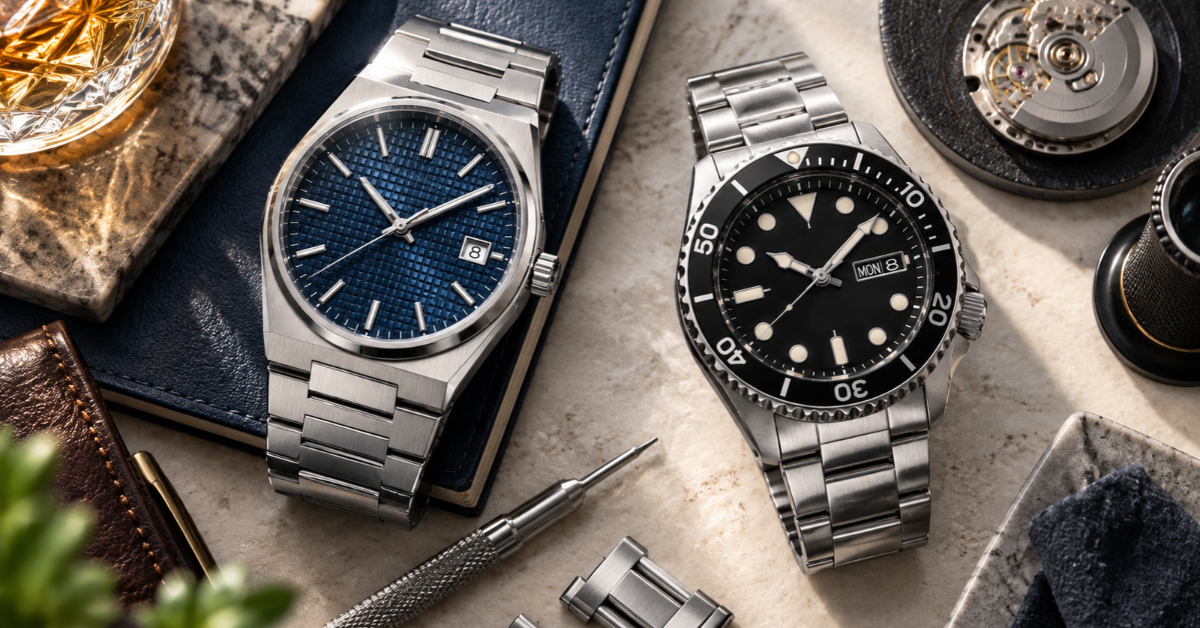
This comparison gets asked constantly because both watches sit at the top of their respective "best value automatic" conversations, just at different price points. It's worth being honest about that difference rather than pretending this is an even fight, because it isn't, and knowing exactly where the gap is makes the actual decision easier.
Where Each One Comes From
The Seiko 5 line traces back to 1963, built around five defining principles: automatic winding, a day-date display, water resistance, a recessed crown, and durable case construction. The current generation, introduced in 2019, updated that formula with a more modern sport-watch case and the newer 4R36 movement, positioned as Seiko's benchmark affordable automatic — reliable, widely serviced, and priced to be a genuinely low-risk first mechanical watch.
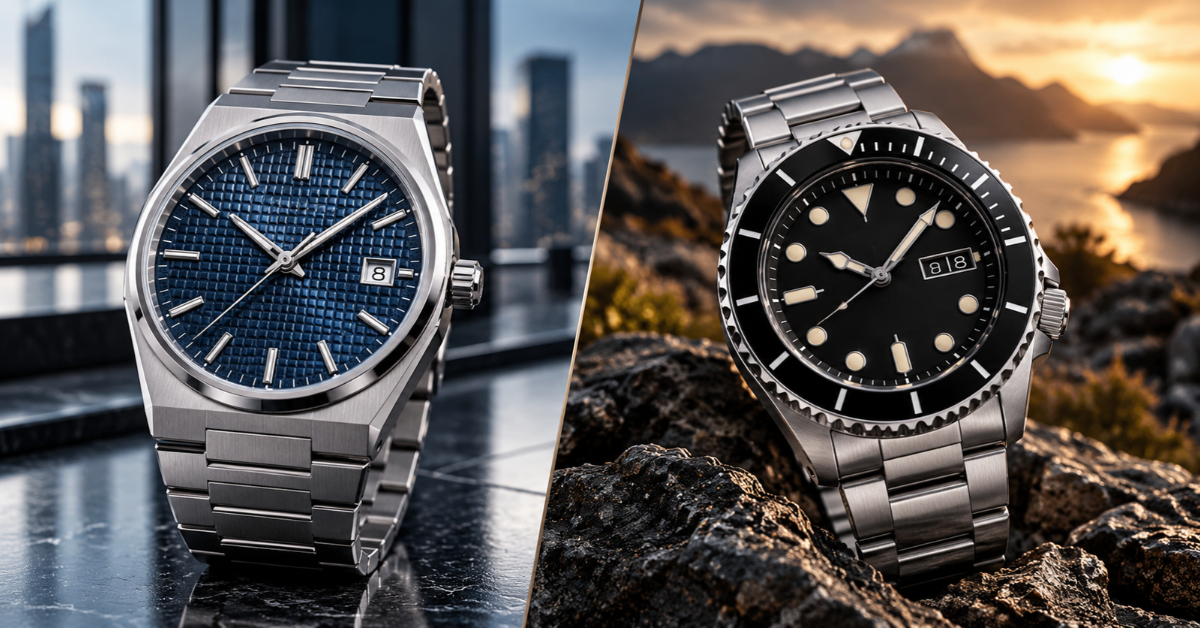
The Tissot PRX Powermatic 80 comes from a different tradition entirely. It revives a 1978 design, discontinued not long after launch and rediscovered in Tissot's own archives before its 2021 relaunch. Our PRX complete guide covers that history in full — it's a design-forward, integrated-bracelet watch built to punch above its price on finishing and case execution, not simply the most affordable path into automatic ownership.
The Movement: A Shared Beat Rate, a Real Power Gap
This is the most interesting technical overlap, and it's worth pointing out directly: both watches run at 21,600 vibrations per hour, a slower frequency than the 28,800 vph common on higher-end automatics. Our Powermatic 80 explainer covers why that trade-off exists on the Tissot side — a slightly less smooth sweep in exchange for extended running time.
That's where the similarity ends, though. Seiko's 4R36 delivers roughly 41 hours of power reserve, meaning it can stop if left unworn over a weekend. The Powermatic 80 nearly doubles that at roughly 80 hours, comfortably surviving a weekend on the nightstand. Both movements offer hacking seconds and hand-winding capability, and both are genuinely serviceable, not sealed disposable units.
On accuracy, Seiko states a factory tolerance of +45/-35 seconds a day for the 4R36, though real-world examples commonly run closer to plus or minus 10 to 15 seconds daily. Tissot doesn't publish an equivalently wide factory tolerance for the Powermatic 80, and the two aren't tested to a directly comparable public standard, so it's fairer to say both perform well within normal expectations for automatics at their respective price points rather than claim one is definitively more accurate.
Crystal and Case: Where the Price Gap Actually Shows
This is the most concrete material difference, and it's worth being specific about it rather than glossing over it. The Seiko 5 uses Hardlex, a proprietary mineral crystal that resists scratching reasonably well but is genuinely softer than sapphire. The PRX Powermatic 80 uses sapphire crystal throughout, a harder, more scratch-resistant material that's standard on most Swiss watches at this price tier and above.
Case construction differs in character as much as material. The Seiko 5 uses a fairly conventional cushion or round case design, typically 42.5mm to 45mm depending on reference, with a push-pull rather than screw-down crown on most models. The PRX's integrated-bracelet case is a more deliberately engineered design exercise — the bracelet flows directly from the case with no visible gap, a genuinely harder thing to execute well and a large part of what the PRX is actually known for. Both generally offer 100 meters of water resistance, putting them on comparable practical footing for swimming and daily wear despite the different crown designs.
Price: A Real 2 to 3x Gap
Seiko 5 automatics generally run $200 to $350 new. The PRX Powermatic 80 sits at roughly $650 to $750. That's a genuine, substantial gap, not a rounding difference, and it's worth being honest about what it buys: sapphire crystal, double the power reserve, and the PRX's specific integrated-bracelet design and finishing, all backed by Tissot's Swiss manufacturing base. It does not buy you a fundamentally different ownership experience in day-to-day accuracy or reliability — Seiko's reputation for durability is well earned, and the 4R36 is a proven, widely serviced movement in its own right.
So, Which One Is Actually Worth Your Money?
Neither is the wrong answer — they're solving different problems.
- Want the lowest-risk, most widely recommended entry point into automatic watches, full stop? The Seiko 5 earns that reputation honestly, and the money you save is real money, not a compromise you'll regret.
- Want sapphire crystal, a genuinely long power reserve, and a specific, celebrated design you won't outgrow as your taste develops? The PRX Powermatic 80 delivers that, and the price difference reflects real material and design choices, not just a Swiss name on the dial.
- Torn between the two specifically because of budget? That's a legitimate place to be, and it's worth trying both in person if you can — the case feel and bracelet integration on the PRX in particular are hard to fully judge from specs alone.
If you're deciding within Tissot's own lineup rather than against Seiko, our PRX vs PRX Powermatic 80 comparison and our Tissot Price Guide cover where the Powermatic 80 sits against Tissot's other options.
Caring for Either Watch
Both are genuinely serviceable movements built to last with routine care — avoiding magnets, periodic water resistance checks, and servicing roughly every few years. Our Tissot Maintenance Guide covers what that looks like specifically for a Powermatic 80.
FAQ
Is the Tissot PRX Powermatic 80 better than a Seiko 5?
It depends on what you're optimizing for — the Tissot offers sapphire crystal, double the power reserve, and a more distinctive integrated-bracelet design, while the Seiko offers a genuinely lower-risk, much cheaper entry into automatic watches.
Do the PRX Powermatic 80 and Seiko 5 use the same movement?
No, but they share the same 21,600 vibrations-per-hour beat rate — Tissot's Powermatic 80 delivers roughly 80 hours of power reserve, while Seiko's 4R36 delivers about 41 hours.
Why does the PRX Powermatic 80 cost so much more than a Seiko 5?
Sapphire crystal versus Hardlex, roughly double the power reserve, and the PRX's specifically engineered integrated-bracelet case all contribute to the roughly 2 to 3 times price difference.
Is a Seiko 5 a good first automatic watch?
Yes — it's widely considered one of the lowest-risk entry points into mechanical watches, with a proven movement and a wide service network.
Does the Seiko 5 have sapphire crystal?
No — it uses Hardlex, a scratch-resistant mineral crystal, but genuinely softer than the sapphire crystal used on the PRX Powermatic 80.
Conclusion
This comparison works best when you stop looking for one watch to definitively win and instead match the choice to your actual budget and priorities. The Seiko 5 is a genuinely smart, low-risk automatic that doesn't apologize for its price. The PRX Powermatic 80 spends real money on sapphire crystal, extended power reserve, and a case design that's become one of the most talked-about in accessible Swiss watchmaking. Both are honest, well-built answers to different versions of the same question.
Senior Writer
James Whitfield
Senior watch writer with a decade covering Swiss horology, vintage markets and modern releases.