On this page
- Shared Foundation
- Water Resistance: A Real Functional Gap, Not Just a Bigger Number
- The Helium Escape Valve: The 2000's Real Differentiator
- ISO 6425 Certification: A Real, Verifiable Credential
- The 2026 Redesign: Smaller, and Actually Cheaper
- Dial and Bezel: Where the Extra Cost Also Shows
- Case Size and Fit
- Pricing: Roughly $250 to $400 Apart
- So, Which Should You Actually Buy?
- Buying With Confidence
- FAQ
- Conclusion
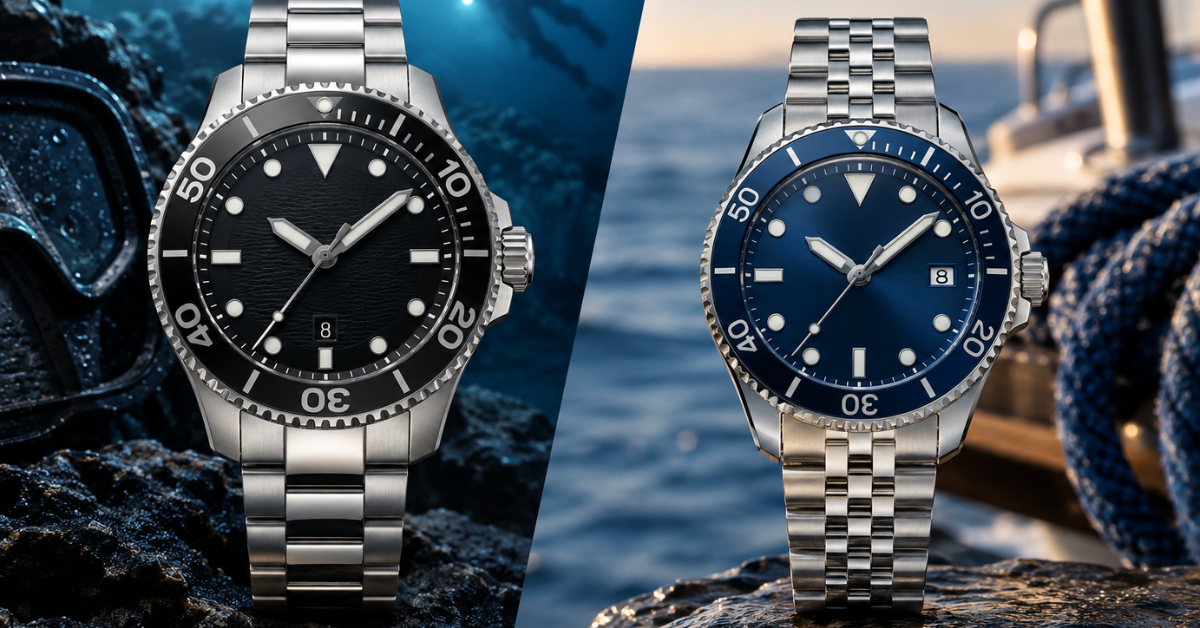
The Tissot Seastar 1000 and Seastar 2000 Professional share the same Powermatic 80 movement family but differ in genuine capability, not just marketing. The Seastar 1000 offers 300 meters of water resistance in a 43mm case, generally $600 to $800. The Seastar 2000 Professional offers 600 meters, a functional helium escape valve, and full ISO 6425 dive-watch certification, now in a 2026-redesigned 44mm case — down from 46mm — priced from roughly $975 to $1,050. For most buyers, the Seastar 1000 covers real-world diving needs; the Seastar 2000 is for buyers who specifically want the full professional-grade credential set.
Both watches trace back to the same 2021 Seastar relaunch and share a family resemblance strong enough that they're easy to mix up at a glance. The differences that actually matter aren't cosmetic, though — they come down to genuine functional capability, and a significant 2026 redesign has changed exactly how much size you're trading for that added capability. This comparison covers both honestly.
Shared Foundation
Both watches run Tissot's Powermatic 80 movement, delivering roughly 80 hours of power reserve — more than double what a standard automatic offers. Our Seastar 1000 review covers that movement's real-world performance in detail, including the honest trade-off of a slightly less smooth sweep in exchange for the extended reserve — a trade-off that applies equally to the Seastar 2000, since it runs the same movement family.
Water Resistance: A Real Functional Gap, Not Just a Bigger Number
This is the most obvious difference, and it's genuinely functional rather than cosmetic. The Seastar 1000 delivers 300 meters of water resistance — more than sufficient for swimming, snorkeling, and recreational diving. The Seastar 2000 Professional doubles that to 600 meters, a specification that starts to matter for genuine technical and saturation diving rather than recreational use.
For the overwhelming majority of buyers, neither number will ever be tested anywhere close to its limit. But the gap isn't purely academic — it reflects a genuinely more robust case construction and sealing system on the 2000, not just a different number printed on the dial.
The Helium Escape Valve: The 2000's Real Differentiator
This is the feature that actually separates a "professional-grade" dive watch from a capable everyday diver, and it's exclusive to the Seastar 2000. Positioned at 9 o'clock, the valve allows accumulated helium to escape safely during saturation diving, when ambient pressure drops faster than trapped gas can otherwise vent through the case seals. It's a genuinely functional component, not decorative — and it's specifically the feature that lets Tissot count itself among a fairly small group of brands offering a helium valve at a price just over $1,000.
If you're not doing commercial saturation diving, you'll likely never need it in practice. But its presence is a meaningful signal of what the rest of the watch's engineering was built to support, not just a spec-sheet flourish.
ISO 6425 Certification: A Real, Verifiable Credential
The Seastar 2000 Professional carries full ISO 6425 certification — an official international dive-watch standard requiring specific, independently verifiable testing across water resistance, magnetic resistance, shock resistance, and chemical resistance. The Seastar 1000 doesn't carry this certification. This is worth understanding as a genuine, checkable credential rather than marketing language: ISO 6425 compliance means the watch has actually been tested to a defined standard, not just assumed capable based on its water resistance rating alone.
The 2026 Redesign: Smaller, and Actually Cheaper
This is the development that meaningfully changes how this comparison should be read in 2026 specifically. Tissot redesigned the Seastar 2000 Professional this year, reducing the case from 46mm to 44mm in diameter and trimming thickness from roughly 16.3mm down to 15.29mm — genuinely significant reductions on a feature-dense dive watch, where even a couple of millimeters noticeably changes how the watch sits on the wrist. Reviewers who tested both generations describe the change as transforming the watch from an oversized presence into something genuinely wearable for daily use.
Unusually, that size reduction came with a price drop rather than the premium you might expect from a running update — the new 44mm Seastar 2000 Professional starts around $975 to $1,050, down from the previous 46mm generation's roughly $1,275. None of the core specification was watered down to achieve that: the 600-meter rating, ISO 6425 certification, helium valve, and ceramic bezel insert all carried over unchanged.
Dial and Bezel: Where the Extra Cost Also Shows
Beyond the technical specifications, the Seastar 2000 also presents as the more finished watch. Its bezel uses an engraved ceramic insert with genuine depth, compared to the Seastar 1000's flatter ceramic insert, and the 2000's dial carries a textured wave pattern that reads as more detailed and dimensional than the Seastar 1000's comparatively plain dial layout — a difference our Seastar 1000 review noted honestly as one of that watch's real trade-offs for the lower price.
Case Size and Fit
Even after the 2026 downsizing, the Seastar 2000 remains the larger watch — 44mm against the Seastar 1000's 43mm, with a genuinely thicker profile at roughly 15.29mm compared to the 1000's roughly 12.6mm to 12.7mm. That's a real difference on the wrist, not just a number on a spec sheet, and worth trying on in person if you have a smaller wrist or generally prefer a slimmer daily watch.
Pricing: Roughly $250 to $400 Apart
Current pricing puts the Seastar 2000 Professional at approximately $250 to $400 more than the Seastar 1000, depending on the specific configuration and strap or bracelet choice on either watch. That gap buys the doubled water resistance, the helium valve, ISO 6425 certification, and the more detailed dial and bezel finishing — a genuine, defensible set of upgrades rather than just a bigger number for its own sake.
So, Which Should You Actually Buy?
- Want genuine dive-watch capability that covers real-world swimming and recreational diving, at the lower price? The Seastar 1000 delivers that honestly, and our full review covers exactly where its trade-offs show up.
- Want the full professional-grade credential set — deeper rating, helium valve, ISO 6425 certification — and don't mind the larger case and higher price? The 2026-redesigned Seastar 2000 makes that case more compellingly than any previous generation, now that the size penalty has shrunk considerably.
- Have a smaller wrist or strongly prefer a slimmer watch? The Seastar 1000's smaller, thinner case is the more comfortable everyday choice regardless of the capability gap.
Neither watch is a compromised version of the other — they're built around genuinely different depth-of-capability targets, and the right choice depends on whether you actually need what the extra capability provides.
Buying With Confidence
Whichever Seastar you choose, buying from an authorized retailer removes any authentication risk. Our guide on authenticating a Tissot against "Swiss Made" fakes covers what to check before any purchase, new or pre-owned.
FAQ
What's the main difference between the Tissot Seastar 1000 and Seastar 2000? The Seastar 2000 Professional offers 600 meters of water resistance, a functional helium escape valve, and ISO 6425 certification, compared to the Seastar 1000's 300 meters and no helium valve or ISO certification.
Did the Tissot Seastar 2000 get smaller in 2026? Yes — Tissot redesigned it from a 46mm to a 44mm case, also reducing thickness from roughly 16.3mm to 15.29mm, while keeping all core specifications, including the 600m rating and ISO 6425 certification, unchanged.
Is the Seastar 2000 worth the extra cost over the Seastar 1000? It depends on whether you need the added capability — the roughly $250 to $400 premium buys genuinely more robust engineering, but most recreational buyers will never test either watch's water resistance anywhere near its limit.
Do both Seastar models use the same movement? Yes — both run Tissot's Powermatic 80, delivering roughly 80 hours of power reserve.
Which Seastar is better for a smaller wrist? The Seastar 1000, at 43mm and roughly 12.6mm thick, wears noticeably more compactly than the Seastar 2000's 44mm, 15.29mm case, even after the 2026 size reduction.
Conclusion
The gap between these two watches used to be mostly about size — a genuinely capable diver in a more wearable case, against a more serious tool watch that wore like one. The 2026 redesign narrowed that gap considerably without giving up any of the Seastar 2000's real engineering advantages, which makes this a closer call than it's been in past years. Choose based on whether the helium valve and ISO 6425 certification actually matter to how you'll use the watch, not just which number looks more impressive on a spec sheet.
Senior Writer
James Whitfield
Senior watch writer with a decade covering Swiss horology, vintage markets and modern releases.