On this page
- What Does PRX Actually Stand For?
- Design Origin: Born From the 1978 Quartz Crisis
- Modern Relaunch: 2021 and the "Gateway Luxury Watch" Reputation
- Key Variations and Models
- Where the PRX Fits in Tissot's Broader Catalog
- The Movement Technology Behind It
- Why the PRX's Swiss Manufacturing Matters
- Buying With Confidence
- FAQ
- Conclusion
PRX stands for "Precise and Robust," with the X a Roman numeral for 10, referencing the watch's 10-bar (100-meter) water resistance. Tissot first registered the name in 1978 for a quartz sports watch originally sold as the Seastar, built with a flat tonneau case and an integrated steel bracelet during the industry's "quartz crisis" era. The design sat dormant in Tissot's archives for decades before being reintroduced in February 2021, becoming one of the most successful modern Swiss watches under $1,000. It's now available in Quartz and Powermatic 80 automatic versions, spanning 35mm to 40mm steel cases, plus newer 38mm references in premium materials.
What Does PRX Actually Stand For?
The name is a literal spec sheet, not a stylistic flourish. "PR" stands for Precise and Robust — a direct claim about the watch's accuracy and build quality. The "X" is a Roman numeral for 10, referencing the case's 10-bar water resistance rating, equivalent to 100 meters. Tissot's own official materials confirm this reading, describing the name as one "defined by precision and robustness, with an X that nods to its 10-bar water resistance." It's a detail worth knowing before anything else about this watch, since the name itself tells you exactly what Tissot originally built it to do.
Design Origin: Born From the 1978 Quartz Crisis
Tissot launched the original watch in 1978, in the middle of one of Swiss watchmaking's most disruptive periods. The "quartz crisis" saw inexpensive, highly accurate quartz movements from Japan undercut traditional Swiss mechanical manufacturers throughout the 1970s, and rather than resist that shift, Tissot leaned directly into it — using the thinness and precision quartz movements allowed to build a slim, angular, tonneau-shaped case with a fully integrated steel bracelet.
The watch was originally sold under the name Seastar, distinguished by a flat, multi-faceted barrel case and wide, flexible horizontal bracelet links that flowed directly into the case rather than attaching via traditional lugs. That integrated-bracelet design rode the same "luxury sport" wave Gérald Genta had ignited a few years earlier with the Audemars Piguet Royal Oak — Tissot's version brought that same design language to a considerably more accessible price point. Shortly after launch, Tissot registered the PRX name specifically to capture the watch's technical identity, and it stuck.
The original didn't last long in production. Like much of Swiss analog watchmaking, it was discontinued in the early 1980s as Japanese digital watches took over that segment of the market, and the design sat largely forgotten in Tissot's archives for close to four decades.
Modern Relaunch: 2021 and the "Gateway Luxury Watch" Reputation
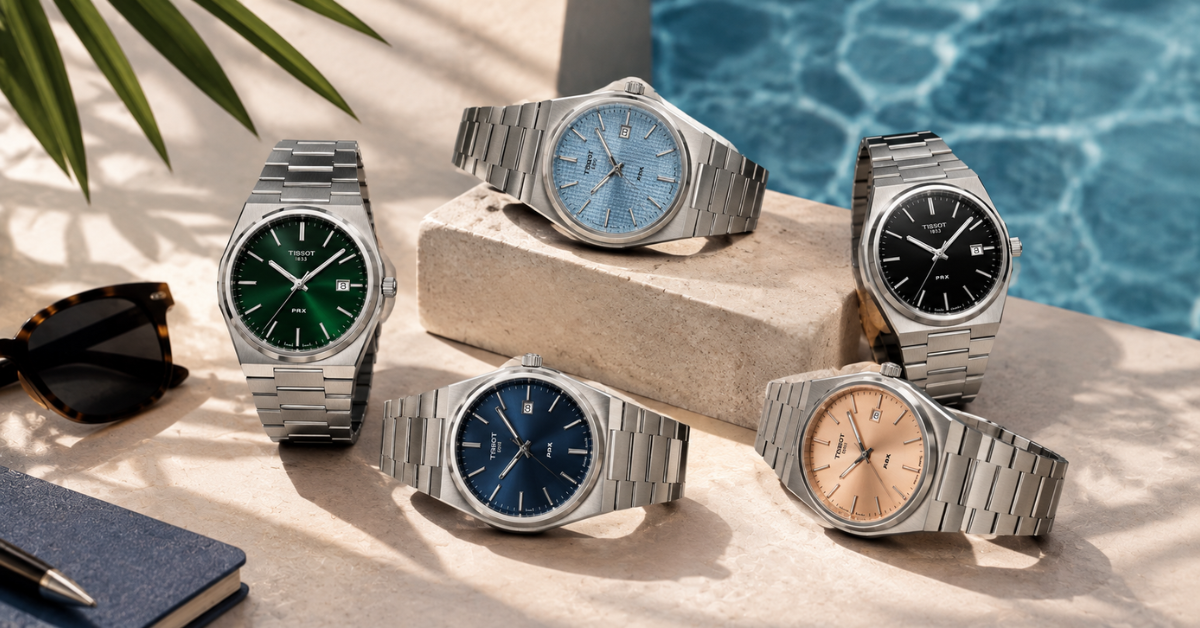
Tissot rediscovered the original PRX in its own archives and officially relaunched the collection on February 26, 2021, staying remarkably faithful to the 1978 original's proportions and integrated-bracelet silhouette while updating the finishing and movement technology throughout. The response was immediate and, by most industry accounts, larger than Tissot itself anticipated — the revived PRX became one of the most talked-about Swiss watches in its price category, frequently cited as a benchmark "gateway luxury watch" for buyers moving up from mass-market brands into genuine Swiss watchmaking.
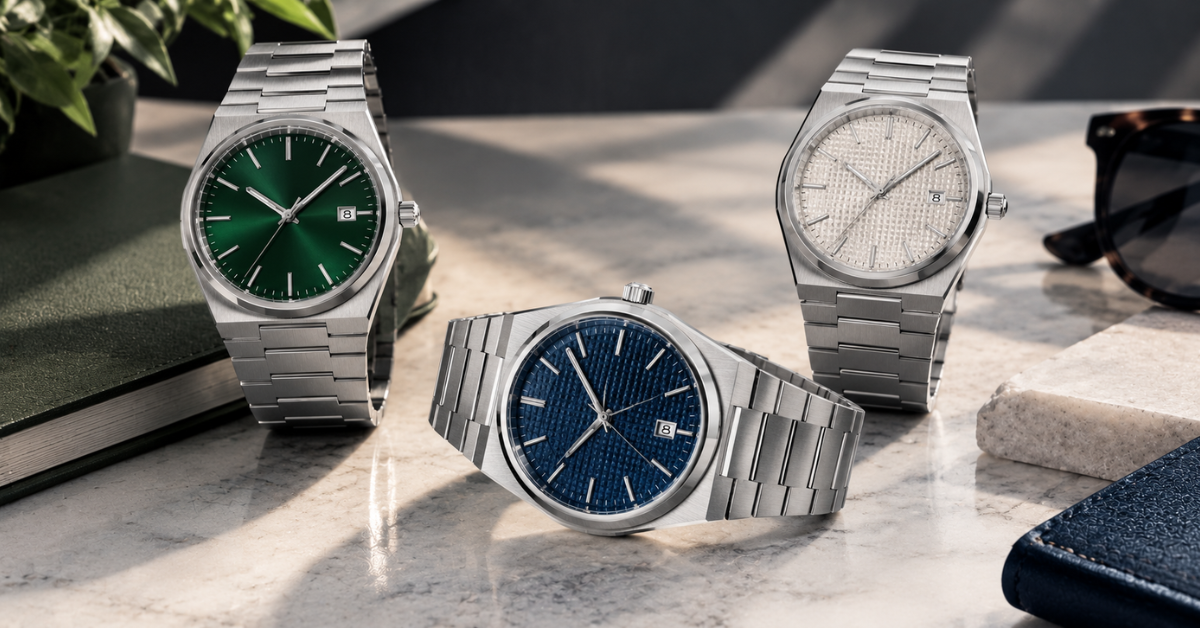
Much of that reputation comes down to execution rather than nostalgia alone: alternating brushed and polished surfaces across the case and bracelet that read as considerably more expensive than the price tag suggests, at a fraction of what a comparable integrated-bracelet sport-luxury watch costs from higher-tier Swiss brands.
Key Variations and Models
The current PRX lineup splits primarily along movement lines, with real differences in thickness, price, and case options between them.
PRX Quartz is the direct descendant of the 1978 original in spirit — slim, accurate, and effectively maintenance-free. It runs Tissot's ETA F06.115 movement, accurate to roughly ±10 seconds per month with a battery rated to last around a decade, inside a case generally measuring 9.6mm to 10.4mm thick depending on reference. It's available at both 35mm and 40mm, with a sunburst dial finish and a solid caseback, and typically retails $375 to $425.
PRX Powermatic 80, introduced in 2021 alongside the quartz relaunch and expanded through 2023, adds Tissot's automatic movement platform with an 80-hour power reserve, an exhibition caseback showing off the finished movement, and a distinctive textured waffle dial that distinguishes it visually from the quartz version at a glance. It runs thicker, generally 10.9mm to 11.3mm, and retails $650 to $750. It launched in 35mm and 40mm case sizes, notably skipping the in-between 37-38mm size many enthusiasts had asked for.
PRX Powermatic 80 in 38mm, introduced in late 2025, closed that sizing gap — though as of this writing, it's available only in premium case materials like titanium and Damascus steel rather than standard steel, at a correspondingly higher price.
Two-tone and precious metal configurations extend the collection further, including steel-and-gold Powermatic 80 references that pair gold accents on the bezel and bracelet with the same 80-hour movement and exhibition caseback found on the standard steel version, aimed at buyers who want a more overtly luxurious presence without leaving the PRX design language.
For a full side-by-side breakdown of exactly what changes between the Quartz and Powermatic 80 versions — movement, thickness, price, and which buyer each one actually suits — our PRX vs PRX Powermatic 80 comparison covers that decision in full detail.
Where the PRX Fits in Tissot's Broader Catalog
The PRX sits at a specific, well-defined point in Tissot's lineup — more design-forward and recognizable than the brand's classical dress lines, and priced well below Tissot's precious-metal Heritage pieces. Our Tissot Price Guide breaks down how the PRX's pricing compares across the full catalog, and if you're shopping specifically at the Quartz version's price point, our Best Tissot Watches Under $500 guide covers it alongside Tissot's other strongest picks in that range. The Powermatic 80 version, similarly, is one of the strongest automatic picks in our Best Tissot Watches Under $1,000 roundup.
The Movement Technology Behind It
The Powermatic 80's 80-hour power reserve is a genuine engineering trade-off worth understanding, not just a marketing number — it's achieved partly by reducing the movement's operating frequency, which produces a slightly less smooth second-hand sweep than a standard higher-frequency automatic in exchange for that extended running time. Our Tissot Movements Explained guide covers that trade-off, and how the Powermatic 80 platform compares to Tissot's other movement families, in full technical depth.
Why the PRX's Swiss Manufacturing Matters
Every PRX, regardless of movement, is built under the same "Swiss Made" legal standard that applies across Tissot's catalog — final assembly and movement inspection happening in Switzerland, tracing back to Tissot's home manufacturing base in Le Locle. Our piece on Tissot's Le Locle heritage covers what that designation actually requires and why it's more than a phrase printed on the dial.
Buying With Confidence
The PRX's popularity has made it one of the more frequently counterfeited Tissot references specifically because it's so recognizable. Buying from an authorized retailer removes any authentication guesswork entirely. Our guide on authenticating a Tissot against "Swiss Made" fakes covers what to check before any purchase, new or pre-owned.
FAQ
What does PRX stand for in Tissot watches? "PR" stands for Precise and Robust, describing the watch's accuracy and build quality, while the "X" is a Roman numeral for 10, referencing its 10-bar (100-meter) water resistance rating.
When was the original Tissot PRX released? The original design launched in 1978, initially sold under the name Seastar, before Tissot registered the PRX name shortly after to reflect the watch's technical attributes.
Why was the Tissot PRX discontinued and then relaunched? It was discontinued in the early 1980s as Japanese digital watches reshaped that segment of the market, then rediscovered in Tissot's own archives and officially relaunched on February 26, 2021.
What's the difference between the PRX Quartz and PRX Powermatic 80? The Quartz version is slimmer, more accurate day-to-day, and requires only occasional battery changes, while the Powermatic 80 adds a genuine automatic movement with an 80-hour power reserve and an exhibition caseback, at a thicker case and higher price.
What sizes does the Tissot PRX come in? Current references span 35mm and 40mm across both Quartz and Powermatic 80 versions, with a newer 38mm Powermatic 80 introduced in late 2025 in premium case materials.
Is the Tissot PRX considered a good value watch? Yes — it's widely regarded as a benchmark "gateway luxury watch," offering case and bracelet finishing that consistently punches above its price point relative to comparable integrated-bracelet sport-luxury watches from higher-tier brands.
Conclusion
The PRX's name has always been its own explanation — Precise, Robust, and rated to 10 bar, registered in 1978 for a watch that briefly disappeared and then became one of the defining Swiss releases of the past decade once Tissot rediscovered it. Whether you're drawn to the Quartz version's slim, low-maintenance simplicity or the Powermatic 80's genuine automatic engineering, both trace back to the same tonneau-cased original — and both remain some of the strongest value propositions in accessible Swiss watchmaking today.
Senior Writer
James Whitfield
Senior watch writer with a decade covering Swiss horology, vintage markets and modern releases.