On this page
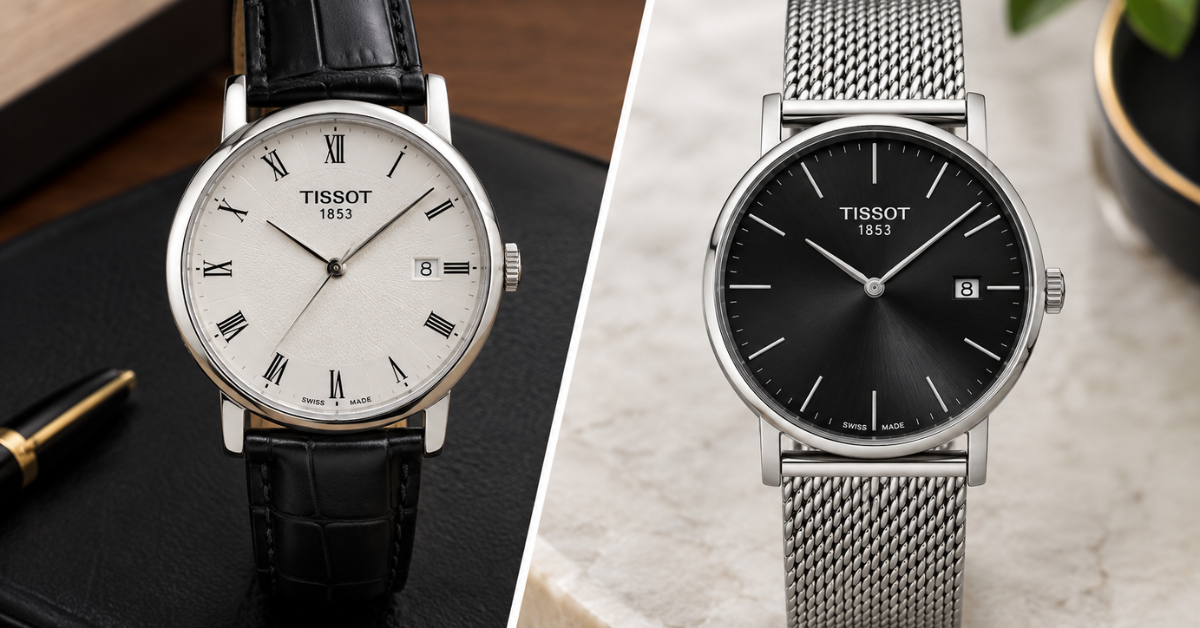
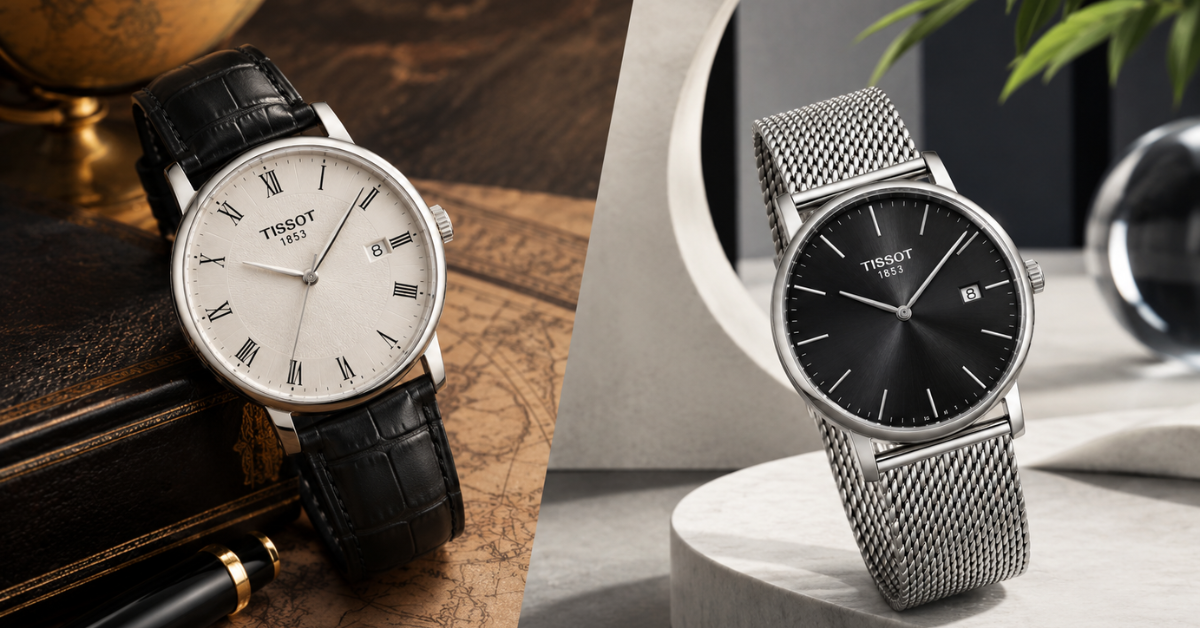
The Tissot Carson and Everytime are both classic dress watches that get overshadowed by the PRX's design-world attention, and buyers frequently ask why they'd pick one over the other given how similar they look at a glance. The real answer: the Everytime is Tissot's most stripped-down option, generally under $400 in quartz with no date window and minimal design flourishes. The Carson spans a considerably wider range — from similarly priced entry quartz models up through genuine Powermatic 80 automatics, chronograph versions, and even precious-metal configurations reaching into the thousands — with a dressier dial featuring elongated hands and more graceful proportions than the Everytime's pared-back simplicity.
This is a comparison real buyers actually ask about, not one invented for content's sake — watch forums regularly feature people staring at both watches side by side, noticing how similar they look, and wondering why one costs more than the other. The honest answer involves genuine differences in design intent and movement range, not just branding. Both deserve more attention than they get, following the same pattern we've covered with other overlooked Tissot classics like the PRC 200.
What the Carson Actually Is
The Carson sits within Tissot's T-Classic collection, positioned by the brand itself as an "all-timer" — a watch built to suit any occasion rather than specializing in one. Its defining visual trait is a graceful dial design with elongated, fine hands, giving it a slightly dressier, more traditional presence than most of Tissot's other classic lines. Case sizes run generally 40mm to 41mm for men's references and 30mm for women's, sized specifically to bridge the gap between larger sport watches and genuinely small traditional dress pieces.
What actually sets the Carson apart is its range. The collection spans simple T-Classic quartz models at the accessible end, Premium quartz references a tier above that, genuine Powermatic 80 automatic versions running Tissot's 80-hour-reserve movement, and even Premium Chronograph references with 30-minute and 1/10-second counters plus ADD and SPLIT timing functions. At the top of the range, the Carson extends into solid gold configurations — genuine precious-metal watches reaching well into four figures, territory the Everytime doesn't touch at all.
What the Everytime Actually Is
The Everytime is Tissot at its most deliberately minimal — a clean dial, no date window, and a design built specifically to disappear under a cuff rather than draw attention. Our Best Tissot Watches Under $500 guide covers it as one of the strongest picks in that price range precisely because it doesn't try to do more than one thing well: tell the time cleanly, in a genuinely versatile size range, without any complication competing for attention on the dial.
Unlike the Carson, the Everytime stays almost entirely within quartz territory across its lineup, without the automatic or chronograph tiers the Carson offers.
The Real Question: Why Does the Carson Cost More?
This is worth addressing head-on, since it's the actual point of confusion that sends people looking for this comparison in the first place. At the entry level, a basic quartz Carson and a quartz Everytime land in a broadly similar price range and can genuinely look alike from a few feet away — same general dress-watch silhouette, similar case proportions. The price gap that develops from there comes down to two real factors: the Carson's dial finishing is a step more elaborate, with those elongated hands and slightly more considered proportions, and the Carson collection simply offers more to choose from — Powermatic 80 automatics, chronograph complications, and precious-metal options that don't exist anywhere in the Everytime lineup. You're not paying more for the same watch; you're paying for a collection with genuine range the Everytime doesn't attempt to match.
Movement Comparison
Both collections offer solid entry-level quartz options, but the Carson pulls ahead considerably once you look past the base tier. Its Powermatic 80 automatic references run the same movement platform covered in our Tissot Movements Explained guide — a genuine 80-hour power reserve automatic, fully serviceable, distinct from Tissot's Swissmatic tier. The Everytime doesn't offer an equivalent automatic option within its own collection, staying focused on quartz simplicity throughout.
Pricing
The Everytime generally runs under $400 across its quartz lineup, consistent with the picks covered in our Under $500 guide. The Carson spans a considerably wider range: basic T-Classic quartz models start in a similar $220 to $350 territory, Premium Powermatic 80 automatic references generally land around $530 to $560, and precious-metal configurations climb into the thousands — a genuine top tier the Everytime simply doesn't have an equivalent for. Our Tissot Price Guide covers how both collections sit within Tissot's broader pricing structure.
So, Which One Should You Actually Buy?
- Want the absolute simplest, most affordable classic Tissot, and don't need automatic or chronograph options? The Everytime delivers that honestly, at the lowest realistic entry point.
- Want room to grow within one collection — quartz now, automatic or chronograph later — or want a dressier dial with more visual character? The Carson's range makes it the more flexible choice long-term.
- Considering a genuine precious-metal dress watch from Tissot specifically? Only the Carson extends that far; the Everytime stays in accessible territory throughout.
- Just want the cleanest possible dial with nothing competing for attention? The Everytime's minimalism is a genuine design choice worth valuing on its own terms, not a lesser version of the Carson.
Caring for Either Watch
Whichever you choose, ongoing care follows the same fundamentals — regular water resistance checks if worn near water, prompt battery replacement on quartz models, and a full service every 3 to 5 years for the Carson's Powermatic 80 automatic specifically. Our Tissot Maintenance Guide covers what that actually involves for both movement types.
Buying With Confidence
Given how closely these two collections can resemble each other in photos, verifying you're getting the specific reference and movement you're paying for matters before any purchase. Our guide on authenticating a Tissot against "Swiss Made" fakes covers the checks worth running, new or pre-owned.
FAQ
Why does the Tissot Carson cost more than the Everytime? The Carson's dial finishing is a step more elaborate, and the collection offers a considerably wider range — including Powermatic 80 automatics, chronograph versions, and precious-metal options — that the Everytime's quartz-focused lineup doesn't include.
Do the Carson and Everytime look similar? At the entry quartz level, yes, closely enough that buyers regularly compare them directly — both share a classic, understated dress-watch silhouette.
Does the Tissot Everytime come in an automatic version? No — the Everytime lineup stays focused on quartz movements, while the Carson offers a genuine Powermatic 80 automatic option with an 80-hour power reserve.
Which Tissot classic is the better value, Carson or Everytime? It depends on what you need — the Everytime offers the lowest-cost entry into genuine Swiss quartz dress watches, while the Carson offers considerably more range if you want room to choose between quartz, automatic, and chronograph options within one collection.
Does the Carson come in gold? Yes — the Carson extends to genuine solid gold configurations at the top of its range, a tier the Everytime doesn't offer.
Conclusion
Neither watch needs to be discovered in the sense of coming back from obscurity — both have been quietly available the whole time, overshadowed by Tissot's more talked-about current releases. The Everytime earns its place through pure, unfussy simplicity at the lowest realistic price point; the Carson earns its place through genuine range, extending from accessible quartz all the way to solid gold. Neither is the "better" watch in the abstract — the right one depends on whether you want the simplest possible classic Tissot or a collection with room to grow into.
Senior Writer
James Whitfield
Senior watch writer with a decade covering Swiss horology, vintage markets and modern releases.