On this page
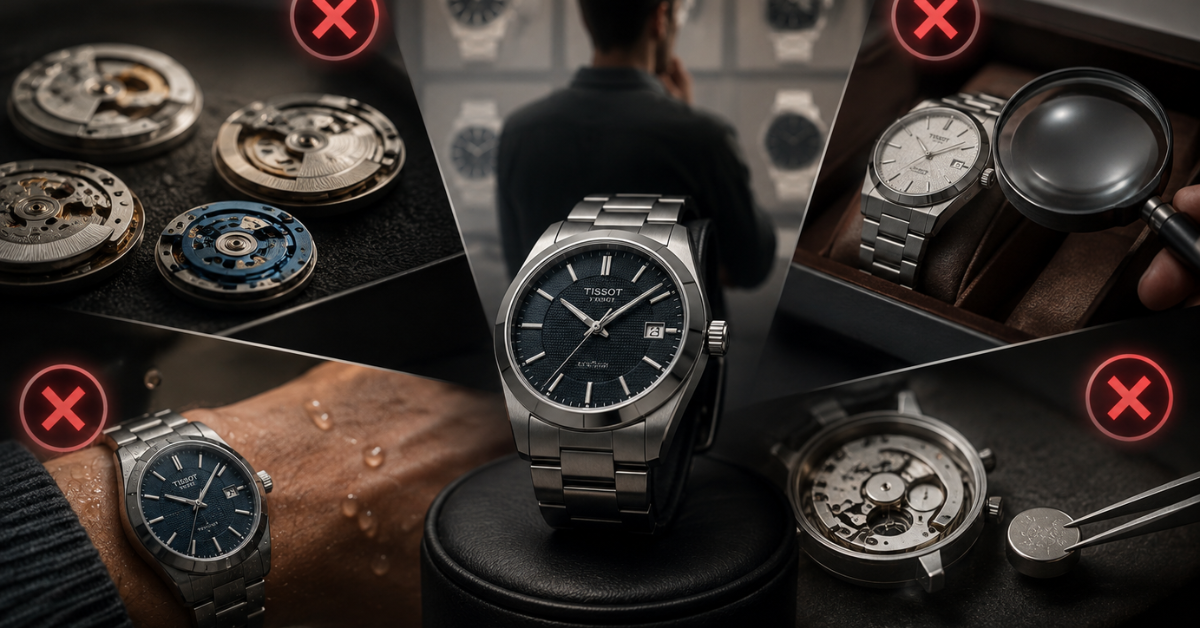
First-time Tissot buyers most commonly go wrong in four ways: assuming every automatic movement in the lineup is equivalent when Powermatic 80, Swissmatic, and standard ETA calibers actually differ in serviceability and performance; buying based on hype rather than understanding what each collection is actually built for; skipping authentication precautions on popular models like the PRX that are frequent counterfeit targets; and assuming a Swiss watch needs no maintenance once purchased. None of these mistakes are about buying the "wrong" watch—they're about buying the right watch without the context that makes ownership actually satisfying.
Most bad first-Tissot experiences don't come from picking a bad watch—Tissot's lineup is strong enough that it's genuinely hard to do. They come from buying the right watch without understanding something that becomes obvious only after the fact. These four mistakes show up constantly, and every one of them is avoidable with information that's already out there.
Mistake 1: Assuming All Tissot Automatics Are Basically the Same
This is the most common misunderstanding, and it's an easy one to fall into since Tissot markets several automatic movement families without always making the practical differences obvious at the point of sale. Powermatic 80, Swissmatic, and standard ETA-based movements all sound similar on a spec sheet — automatic, roughly 21,600 to 28,800 vibrations per hour, reasonable power reserve — but they differ in a way that matters enormously for long-term ownership: serviceability.
Powermatic 80 is fully serviceable by a watchmaker indefinitely. Swissmatic, Tissot's more budget-focused automatic tier, is built as a sealed, non-serviceable module — when it eventually wears out, the standard approach is replacing the whole movement, not repairing it. A buyer who picks a Swissmatic-equipped watch expecting the same decades-long serviceability as a Powermatic 80 is setting themselves up for a genuine surprise ten or fifteen years down the road. Our Tissot Movements Explained guide breaks down exactly what separates these movement families, and it's worth reading before you buy, not after something goes wrong.
Mistake 2: Buying Based on Hype Rather Than Fit
The PRX's popularity is well earned, but it's also created a pattern worth watching for: first-time buyers gravitating toward it specifically because it's the watch everyone's talking about, without stopping to consider whether Tissot's other collections might actually suit them better. The PRX is a design statement — distinctive, recognizable, built to be noticed. The Gentleman, by contrast, is built for quiet daily versatility across more settings, and plenty of owners who've tried both report reaching for the less hyped watch more often once they actually live with it.
This mistake compounds when resale enters the picture. The PRX Quartz specifically has shown notably weak secondary-market performance — our coverage of the fastest-depreciating Tissot model covers exactly why, and it's not a reason to avoid the watch, but it is a reason to buy it for the right reasons rather than assuming hype translates to value retention. If you're weighing collections against each other rather than just chasing the most talked-about option, our Tissot Price Guide and our Gentleman Powermatic 80 review are both worth reading before defaulting to whichever watch has the most buzz.
Mistake 3: Skipping Authentication Precautions Because "It's Just a Tissot"
Here's a genuinely dangerous assumption: that Tissot's accessible pricing somehow makes it a less attractive counterfeit target than a Rolex or Omega. It's the opposite. Precisely because Tissot's popular models — the PRX especially — are recognizable and widely desired at a price point where buyers are more likely to shop marketplaces and private sellers rather than exclusively authorized dealers, they've become frequent counterfeit targets. A first-time buyer who wouldn't dream of skipping authentication on a five-figure luxury watch often doesn't think twice about a $400 marketplace listing, which is exactly the gap counterfeiters rely on.
Our guide on authenticating a Tissot against "Swiss Made" fakes covers the real checks worth running — dial printing, caseback engraving depth, movement finishing — regardless of how modest the price tag seems. The dollar amount at risk doesn't change whether authentication matters; it just changes how easy it is to talk yourself out of bothering.
Mistake 4: Assuming "Swiss Made" Means No Maintenance, Ever
This one shows up later in ownership rather than at the point of purchase, but it's just as common. Plenty of first-time buyers treat "genuine Swiss watch" as shorthand for "never needs attention," when the reality is the opposite: Tissot's own published guidance recommends a complete service every 3 to 5 years for serviceable automatic movements, an annual water resistance check for any watch that sees regular water exposure, and prompt battery replacement on quartz models once the end-of-life indicator appears.
Skipping this isn't a minor oversight — degraded lubrication increases internal friction and accelerates wear on components that would otherwise last decades, and a water resistance rating genuinely fades over time regardless of how carefully the watch is handled. Our Tissot Maintenance Guide covers exactly what routine care actually involves, and it's a genuinely short read relative to how much it can save you in avoidable repairs down the line.
Why These Four, Specifically
None of these mistakes involve buying a bad watch — that's worth repeating, because it's easy to read a list like this as buyer's remorse material. They're all mistakes of missing context: not knowing a movement's real serviceability profile, not knowing a less hyped collection might genuinely suit you better, not extending the same authentication caution to an accessible price point that you would to an expensive one, and not knowing a Swiss watch still needs the same basic care any mechanical or quartz timepiece requires. Every one of them is fixable before you buy, which is the entire point of writing them down.
FAQ
What's the most common mistake first-time Tissot buyers make? Assuming all of Tissot's automatic movements are equivalent, when Powermatic 80 is fully serviceable and Swissmatic is a sealed, non-serviceable module — a distinction that matters significantly for long-term ownership.
Is the Tissot PRX a bad choice for a first Tissot? No — it's a genuinely strong watch, but first-time buyers should choose it because its design and specs actually fit them, not simply because it's the most talked-about current model.
Do I need to authenticate a Tissot the same way as a more expensive luxury watch? Yes — popular, recognizable Tissot models are frequent counterfeit targets precisely because buyers are less likely to apply the same scrutiny at a lower price point.
How often does a Tissot actually need servicing? Tissot recommends a complete service every 3 to 5 years for serviceable automatic movements, along with an annual water resistance check for watches regularly exposed to water.
Does buying a popular Tissot model guarantee good resale value? No — popularity and resale performance aren't the same thing; some widely desired models, including the PRX Quartz, have shown notably weak secondary-market value retention.
Conclusion
Every one of these four mistakes comes down to the same root cause: buying with enthusiasm but without the specific context that makes ownership go smoothly for years rather than just look good on day one. None of it requires becoming an expert before you buy your first Tissot — it just means reading a little further than the marketing copy, checking what you're actually getting before you pay for it, and treating the watch with the same basic care any genuine mechanical or quartz timepiece deserves.
Reviews Editor
Sofia Marchetti
Reviews editor focused on dive watches, chronographs and everyday wearability.